

Tropical Green Juice Blend Sourcing for US and European Importers

The demand for vibrant, fruit-forward beverages continues to reshape the global non-alcoholic drinks landscape. Importers and distributors in the United States and Europe are increasingly looking beyond traditional orange and apple juices, seeking innovative blends that capture consumer attention with bold colors and distinctive flavor profiles. One category gaining significant traction is the tropical green juice segment, where products like the tropical fruit blend drink are setting new benchmarks for what a canned, non-carbonated juice can offer.
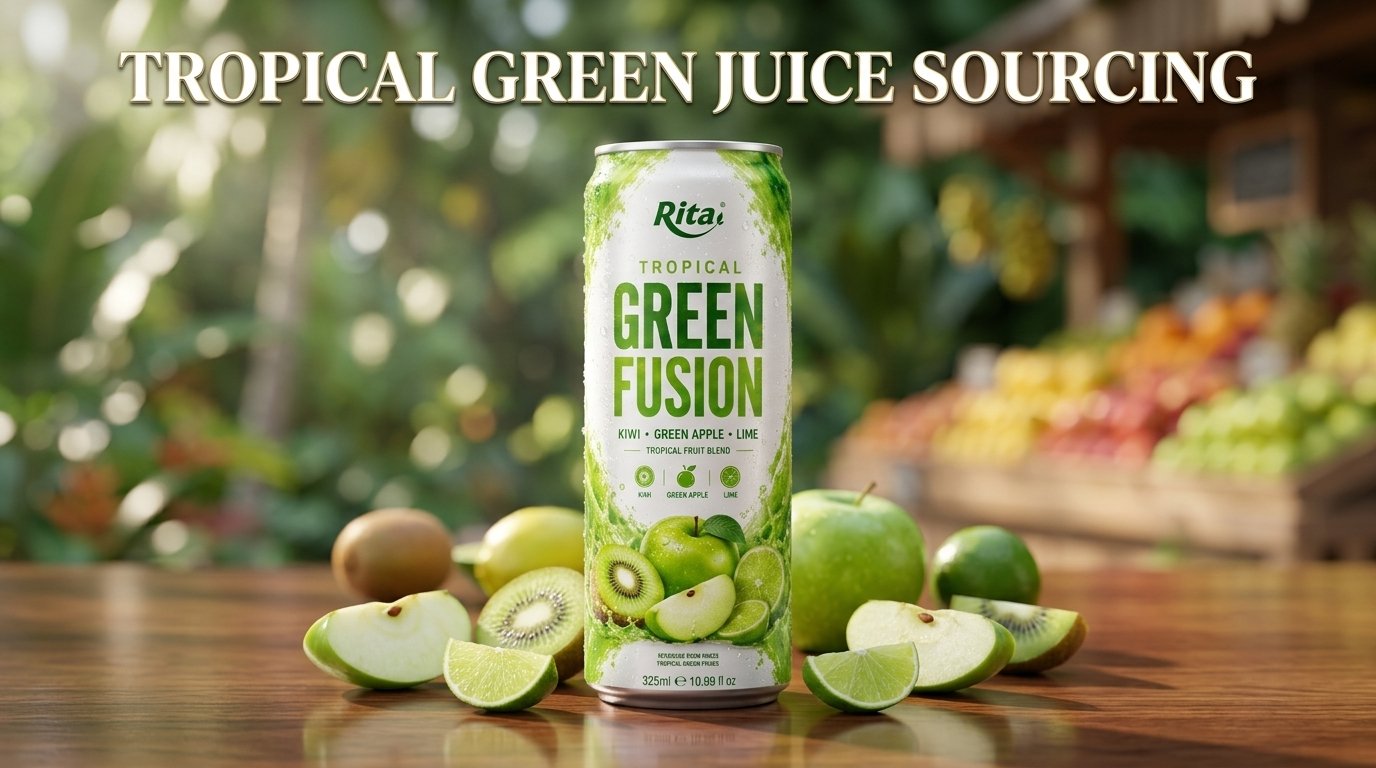
Market intelligence from 2026 indicates that the US and European Union beverage sectors are experiencing a 12% compound annual growth in green-hued fruit drinks, driven largely by Millennial and Gen Z consumers who prioritize sensory appeal and clean-label ingredients. These demographics are actively seeking products that deliver a satisfying taste experience without artificial additives or preservatives. The challenge for importers lies in finding reliable manufacturing partners who can consistently produce high-volume, export-ready products that meet strict regulatory standards across both regions.
Key Takeaways
- The tropical green juice blend market in the US and EU is growing at 12% annually, driven by demand for bold flavors and clean labels.
- Importers should prioritize suppliers with international certifications like BRC, FSSC 22000, HALAL, and KOSHER to streamline customs clearance.
- Products like the tropical fruit blend drink offer versatile applications for standalone retail and mixology channels.
- OEM/ODM capabilities allow distributors to customize sweetness, packaging, and branding for local market preferences.
- Aluminum can packaging (325ml) provides shelf stability and cost-efficient shipping for transatlantic trade routes.
US Market Dynamics: The Rise of Premium Canned Juices
In the United States, the beverage aisle is undergoing a quiet revolution. Shelf-stable canned juices, once relegated to the convenience store segment, are now competing directly with refrigerated options in mainstream grocery chains. According to recent trade data, US imports of tropical fruit juice blends increased by 18% year-over-year in the first quarter of 2026, with a notable shift toward green-colored variants. This trend is particularly strong in coastal markets like California, New York, and Florida, where multicultural populations drive demand for authentic tropical flavors.
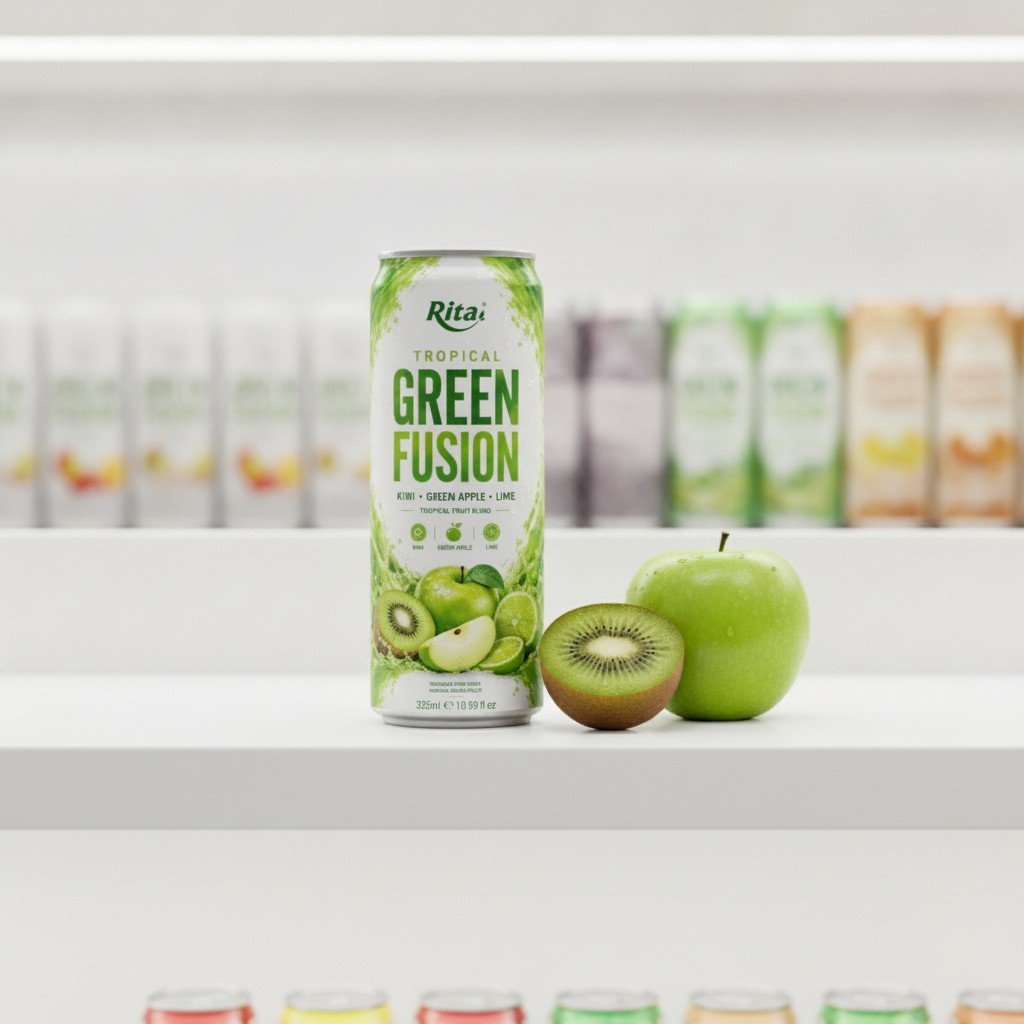
American consumers are drawn to products that offer a point of difference. A kiwi, green apple, and lime combination delivers a visual impact that stands out on crowded shelves. The tart-sweet profile aligns with the growing preference for less sugary beverages, as these fruits provide natural sweetness without relying on added syrups. For importers, this means that a well-positioned green juice can command a premium price point—often $2.50 to $3.50 per 325ml can—while still offering competitive margins for distributors.
Regulatory Pathways for US Entry
Navigating FDA regulations is a critical step for any beverage entering the US market. The product must comply with the Federal Food, Drug, and Cosmetic Act, including proper labeling of ingredients, nutritional facts, and allergen declarations. Importantly, no health claims—functional or otherwise—can be made on packaging or marketing materials. The tropical fruit blend drink from RITA Beverage meets these requirements by focusing purely on flavor, ingredient transparency, and the absence of preservatives. Importers can leverage the manufacturer’s existing certifications—including FDA registration, BRC Food, and FSSC 22000—to expedite customs clearance and reduce compliance risk.
European Union: A Market Primed for Green Juice Innovation
Across the Atlantic, the European Union represents an equally promising opportunity. The EU beverage market is characterized by stringent food safety standards, high consumer expectations for sustainability, and a growing appetite for exotic fruit combinations. In markets like Germany, the Netherlands, and the United Kingdom, tropical green juices have moved from niche health stores to mainstream supermarket chains. The trend is fueled by a cultural shift toward mindful consumption, where shoppers seek products that feel both indulgent and responsible.
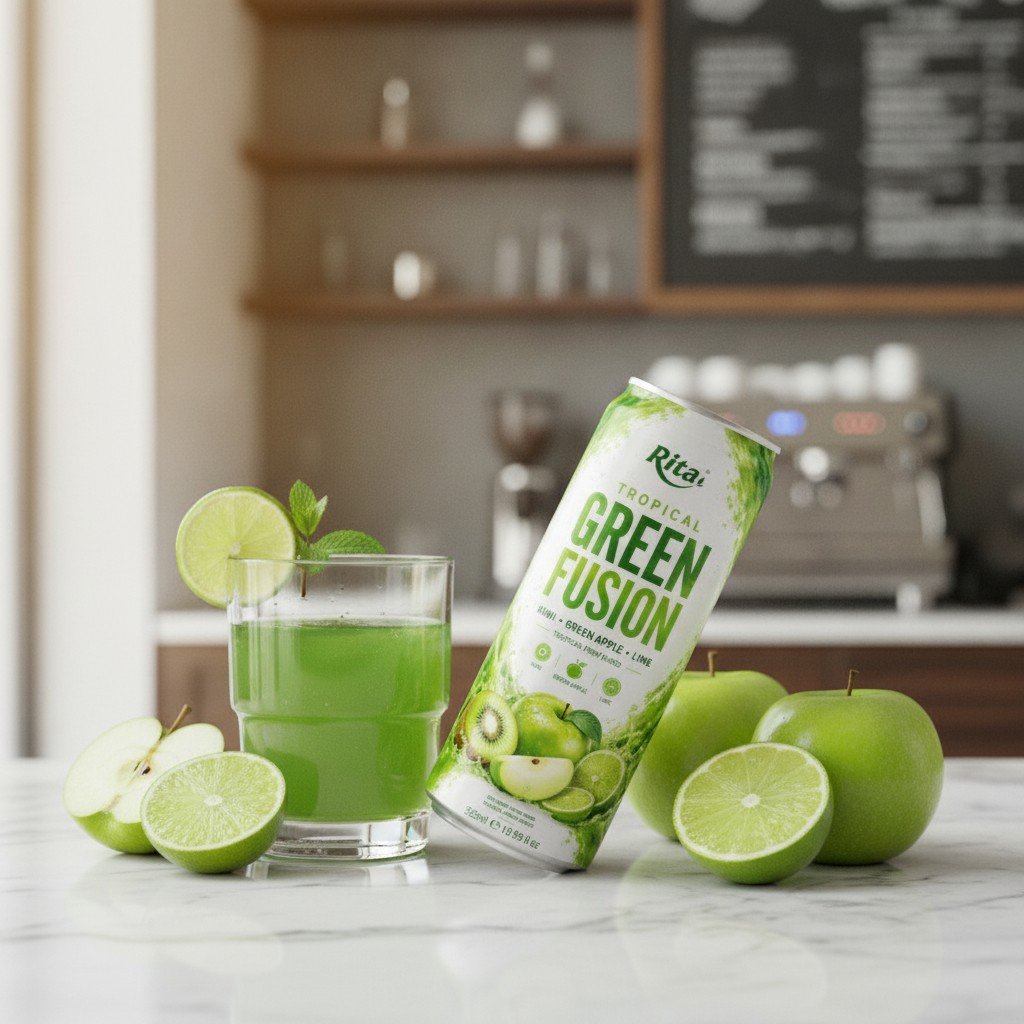
European importers particularly value products that align with the EU’s Farm to Fork Strategy, which emphasizes transparency and reduced food miles. While the tropical fruit blend drink sources ingredients globally—kiwi from New Zealand, green apples from China, and limes from Mexico—the manufacturing process in Vietnam offers a logistical advantage. Vietnam’s strategic position in Southeast Asia allows for efficient shipping to major European ports like Rotterdam and Hamburg, with transit times of approximately 20-25 days. The 325ml aluminum can format is also well-received in Europe, where lightweight, infinitely recyclable packaging is preferred by both retailers and consumers.
Consumer Preferences Across EU Regions
Consumer behavior varies significantly within the EU. In Southern Europe, where fresh fruit consumption is high, shoppers gravitate toward beverages that mimic the taste of freshly squeezed juice. The crisp, tangy profile of the green blend resonates well in Italy and Spain. In Northern Europe, consumers prioritize low sugar content and clean labels—attributes that the product naturally delivers. Importers targeting specific countries can customize the sweetness level through RITA’s OEM/ODM services, ensuring the product matches local palate preferences without compromising on quality.
Supply Chain and OEM/ODM Considerations for Global Distributors
For importers evaluating new suppliers, production capacity and flexibility are paramount. RITA Beverage operates a facility spanning approximately 30,000 square meters with over 50 production lines, capable of producing up to 1,200 containers per month. This scale allows the company to handle bulk orders while maintaining consistent quality across batches. The manufacturer’s OEM/ODM services enable distributors to create private label versions of the tropical fruit blend drink, adjusting the formulation, packaging design, or even the can size to suit local market needs.
One of the most compelling aspects for B2B buyers is the ability to start with a minimum order quantity of 500 cartons per order. This low barrier to entry allows smaller distributors to test the product in their market before committing to larger volumes. For established importers, the supply ability of 1,000 twenty-foot containers per month ensures that scaling up is seamless. The tropical green juice blend is available FOB from Cat Lai Port in Ho Chi Minh City, with flexible payment terms including L/C and T/T.
Packaging Innovation and Export Readiness
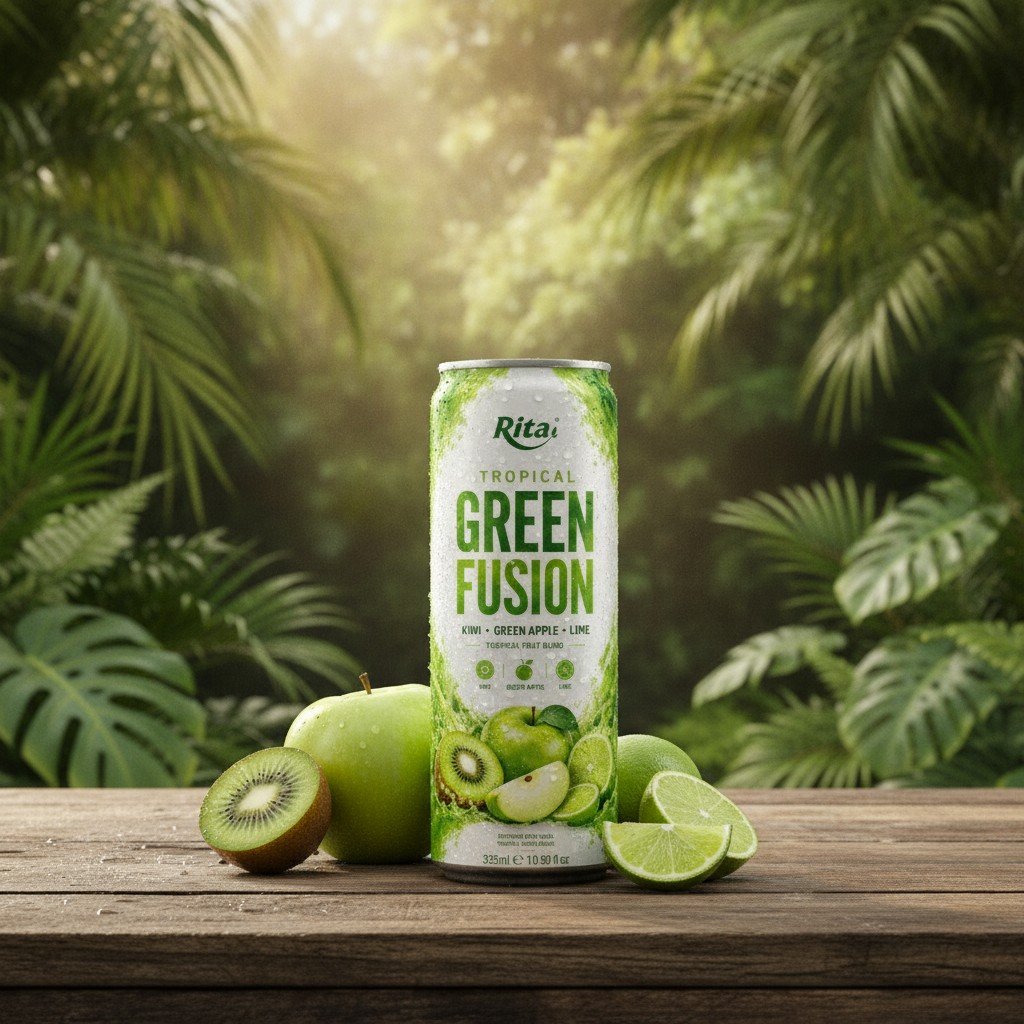
The 325ml aluminum can is not just a packaging choice—it is a strategic decision that impacts logistics, shelf life, and consumer perception. Aluminum cans offer a 24-month shelf life, protecting the juice from light and oxygen while maintaining its vibrant green color. For transatlantic shipments, the lightweight nature of cans reduces freight costs compared to glass bottles. RITA also offers bulk packaging options, including tray packs and shrink-wrapped pallets, which are optimized for container loading. This turnkey approach eliminates the need for importers to manage secondary packaging themselves, reducing supply chain complexity.
Competitive Landscape and Market Positioning
The tropical green juice segment is becoming increasingly competitive, with established brands and new entrants vying for shelf space. However, the market remains fragmented, creating opportunities for importers who can offer a differentiated product. The key differentiator for the tropical fruit blend drink is its unique flavor combination—kiwi, green apple, and lime—which is less common than traditional mango or passion fruit blends. This novelty factor can be a powerful marketing tool, particularly in markets where consumers are fatigued by standard tropical juice offerings.
Importers should also consider the product’s versatility beyond retail. The blend’s balanced sweet-tart profile makes it an excellent mixer for cocktails and mocktails, opening doors to the foodservice sector. Upscale restaurants and bars in cities like London, New York, and Berlin are increasingly incorporating premium canned juices into their beverage programs. By positioning the product as both a standalone drink and a mixology ingredient, distributors can expand their addressable market.
Certifications as a Competitive Advantage
In both the US and EU, certifications serve as trust signals for buyers. RITA Beverage holds HALAL, KOSHER, BRC, and FSSC 22000 certifications, which are highly valued by international retailers and regulatory bodies. These certifications demonstrate a commitment to quality and safety, reducing the due diligence burden on importers. For example, HALAL certification is particularly important for distributors targeting Middle Eastern communities within the US and EU, while KOSHER certification appeals to specific consumer segments in New York and London.
Future Outlook: Growth Projections and Strategic Recommendations
Looking ahead to the remainder of 2026 and beyond, the tropical green juice segment is expected to maintain its upward trajectory. The convergence of consumer demand for visually appealing, clean-label beverages and the expansion of global trade routes will continue to benefit importers who act decisively. To capitalize on this trend, distributors should focus on securing long-term supply agreements with manufacturers that offer both quality and flexibility.
Importers are advised to request samples and conduct blind taste tests with their target demographic before committing to large orders. RITA Beverage offers free samples and free design services for private label partners, allowing distributors to evaluate the product firsthand. Given the minimum order quantity of 500 cartons, initial test runs are feasible for most mid-sized importers. For those looking to explore the category further, the company’s fruit juice product line includes additional tropical variants that can complement the green blend in a broader portfolio.
Frequently Asked Questions
What is the minimum order quantity for the tropical fruit blend drink?
The minimum order quantity is 500 cartons per order. Each carton contains 325ml aluminum cans, and the supplier can accommodate larger volumes up to 1,000 containers per month.
What certifications does the manufacturer hold for export to the US and EU?
The manufacturer holds BRC Food, FSSC 22000, HALAL, KOSHER, and FDA registration. These certifications facilitate customs clearance in both the United States and European Union markets.
Can the product be customized for private label branding?
Yes, the manufacturer offers OEM/ODM services, including custom formulation (adjusting sweetness levels), packaging design, and private label branding. Free design support is available for new partners.
What is the shelf life of the canned tropical green juice?
The product has a shelf life of 24 months when stored in a cool, dry place. The aluminum can packaging protects the juice from light and oxygen, maintaining flavor and color stability.
What are the payment and delivery terms for international orders?
Payment terms include L/C and T/T. Delivery is FOB from Cat Lai Port, Ho Chi Minh City, Vietnam, with a typical lead time of 20-25 days after order confirmation.
Newer news items:
- Wide Opening Can Grape Drink with Nata De Coco Gains Traction in US and Middle East Markets - 25/08/2026 04:23
- Coconut Water With Chocolate Flavor 325ml Sleek Can — A New Frontier in Beverage Innovation - 25/08/2026 04:21
- Qixi 2026 – Rita Food & Drink: Accompanying Meaningful Connection Moments - 19/08/2026 03:11
- Sparkling Lemon Water With Real Fruit Slices — A Premium Trend Reshaping the US and Middle East Beverage Markets - 18/08/2026 04:13
- Premium Real Grape Juice Market Trends and Global Export Opportunities - 14/08/2026 04:11
Older news items:
- Tropical Fruit Juice Blend Market Trends for US and European Importers in 2025 - 12/08/2026 03:54
- Iced Americano Coffee Drink With Green Coconut Flavor — A New Trend in the US and European RTD Coffee Market - 11/08/2026 03:49
- Orange Cream Soda Market Trends for US and European Importers - 10/08/2026 03:46
- Discover the World of Beverages with Rita at VietFood & Beverage 2026 - 08/08/2026 07:23
- Natural Coconut Water Pistachio Drink Market Trends and Opportunities for Global Importers - 06/08/2026 03:45
 084 274 3784788
 No. 8, Thong Nhat Boulevard, Song Than 2 Industrial Park, Di An Ward, HCMC, Vietnam.