

How Purple Compound Juice Fits Europe's Beverage Supply Chain

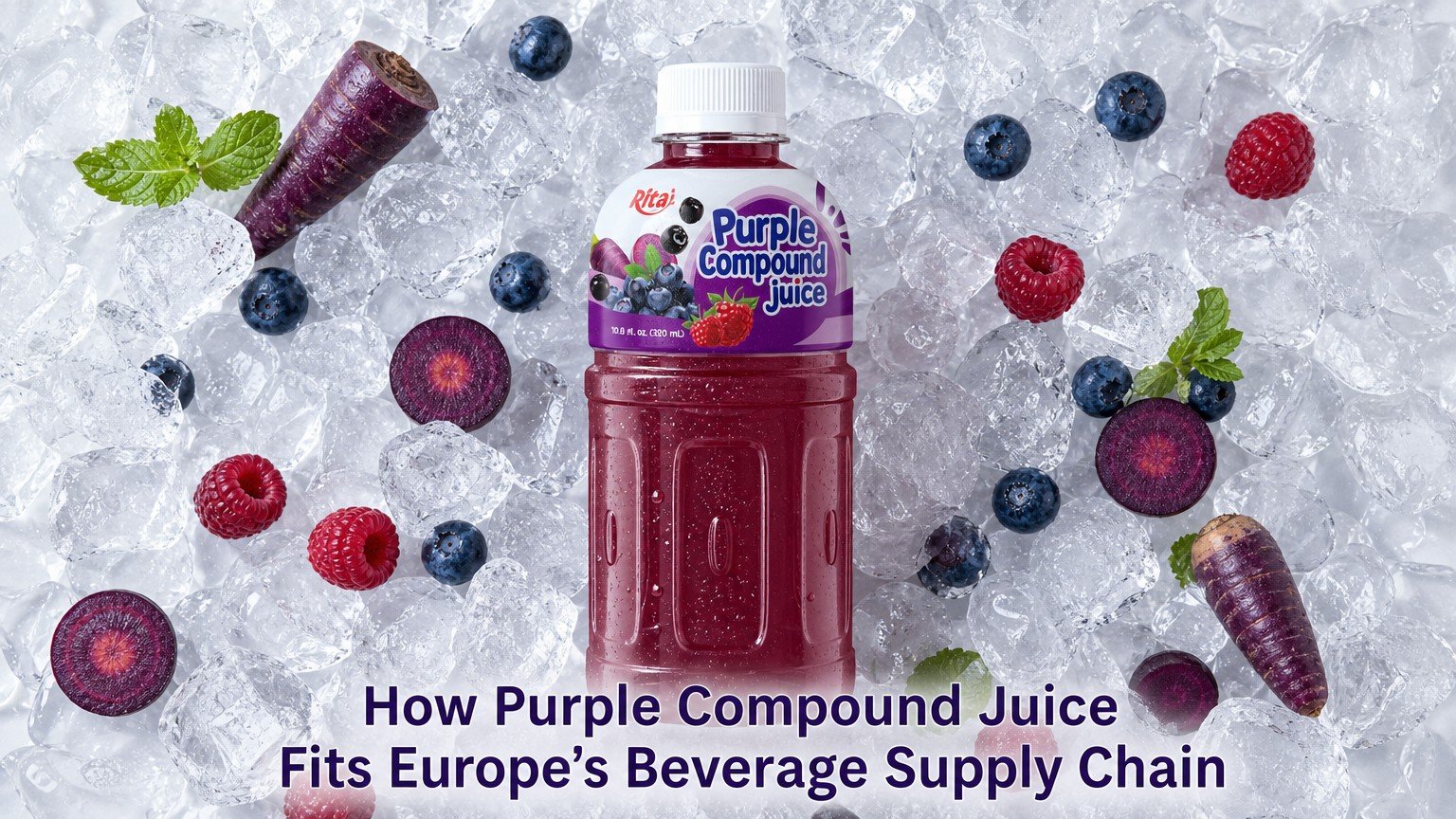
Europe's beverage supply chain is entering a period of recalibration, with packaging contracts reopened, sugar taxation debated and retailers asking harder questions about where their drinks are produced. Into that environment arrives the RITA Purple Compound Juice 320ml PET bottle, a blended fruit and vegetable drink whose vivid purple color and compact format answer several commercial demands at once:
How to differentiate on shelf, how to keep logistics lean and how to deliver a layered taste profile without adding complexity to the route from factory to store. For buyers across Germany, France, the Netherlands, Italy, Spain and the Nordics, the timing is worth a closer look.
Key Takeaways
- Packaging contract reviews, sugar tax campaigns and brewery investments are reshaping supply decisions across Europe.
- The purple compound juice blends blueberries, raspberries and purple carrots into a sweet, tart and earthy profile.
- A 320ml PET bottle supports on-the-go consumption, rapid cooling and dense shelf placement in convenience channels.
- RITA runs 50+ automated production lines and exports to more than 200 countries and territories.
- OEM and ODM programs let European buyers work with a private label juice manufacturer under internationally recognized certifications.
Europe's Beverage Supply Chain Under Pressure
Packaging has become a strategic line item rather than a procurement afterthought for Europe's beverage buyers.
Across the continent, drink companies are renegotiating container supply, reworking label specifications and weighing how new fiscal rules will land with shoppers. For importers, the question is no longer simply what to buy, but how resilient the route from production to shelf will remain over the next planning cycle.
Recent moves illustrate the volatility. In the United Kingdom, brewer Adnams has begun reviewing its packaging contracts, a signal that even established producers are reopening supplier terms in search of cost certainty. German trade bodies have launched an advertising campaign against the country's sugar tax, arguing that the levy complicates formulation and pricing across the soft drinks category. Carlsberg's investment in a German brewery site points in the opposite direction, expressing long-horizon confidence in local production capacity. Each development feeds into the same calculation for buyers: how much risk sits with a single supplier, a single format or a single market.
Competition cases add another layer of uncertainty. Heineken was recently ordered to pay damages in a Greek competition dispute, a reminder that distribution arrangements in Southern Europe remain closely scrutinised. Meanwhile, UK ready-to-drink firm Whitebox Cocktails has entered the US market, showing how quickly a compact format can be redeployed across borders when the packaging already travels well.
For juice buyers, format flexibility is quietly becoming a hedge against that volatility.
A drink that ships in a standard 320ml bottle can move through existing pallet patterns, fit established cooler configurations and be listed in several countries without retooling. That matters when a supplier serves markets as different as Nordic grocery chains and Italian coffee bars. The fewer variables a product introduces, weight, case count, closure type and label size, the more predictable the landed cost becomes, and the easier it is to model shelf performance before committing to a full container booking. In a year when contracts are being reopened anyway, products that ask little of the logistics network hold a structural advantage.
Inside the Purple Compound Juice 320ml PET Bottle
The product itself is deliberately simple to ship and simple to sell.
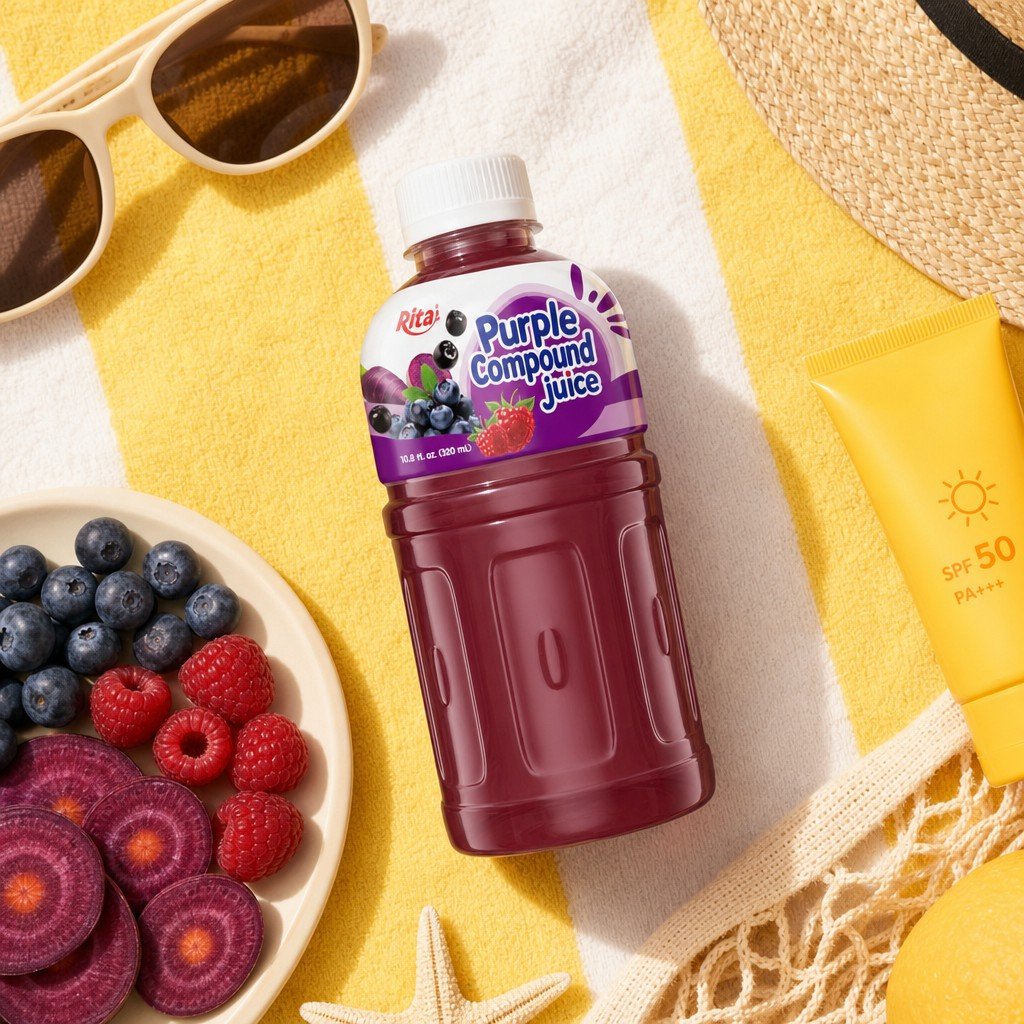
RITA Purple Compound Juice is a ready-to-drink beverage filled in a 320ml recyclable PET bottle with a white screw cap and a colorful label built around berry imagery. The liquid carries a vibrant natural purple hue that reads clearly through the transparent wall, giving the pack strong shelf presence without heavy decoration. Technical buyers reviewing format details, case configuration and export documentation can open the RITA Purple Compound Juice 320ml PET bottle product page, and place the item alongside the rest of the fruit drink catalog when building a mixed container.
A Layered Flavor Profile from Purple Fruits and Vegetables
Taste is built from three purple inputs rather than a single fruit concentrate.
Blueberries bring a rounded sweetness, raspberries contribute a bright tart edge, and purple carrots add an earthy undertone that grounds the finish. The result is a layered profile that moves across sweet, tart and earthy notes instead of resolving into one dominant flavor, which is why the purple compound juice reads as more complex than a straightforward berry drink. That complexity suits a European consumer base accustomed to blended juices and increasingly open to fruit-and-vegetable combinations. It also gives food service operators a versatile base: the same juice can be served chilled on its own or lengthened with soda, tea or citrus to build mocktails and specialty drinks with a consistent, eye-catching color.
The 320ml PET Format Built for On-the-Go Consumption
The bottle is shaped for hands, bags and cup holders rather than for pantry shelves.
It is lightweight, durable and ergonomically contoured for a comfortable grip, so it slips easily into gym bags, lunch boxes and car consoles. At 320ml, the portion is large enough to satisfy and small enough to finish before it warms, which is the consumption pattern convenience channels are built around. Compact packs also cool quickly, a practical advantage in grab-and-go chillers where dwell time is short and shoppers decide in seconds.
From a listing perspective, the small footprint lets retailers fit more facings per linear metre, and the uniform cylinder stacks cleanly in trays and on pallets. For wholesalers, that translates into denser loads and fewer handling touches between port and store. The format has become a default for European convenience precisely because it balances consumer convenience with the arithmetic of distribution, and it gives buyers a familiar pack to work with when testing a new flavor in an unfamiliar market.
From Our Orchards: Raw Material Sourcing
Consistent color starts long before the filling line.
The purple character of the drink depends on raw materials whose pigment and flavor hold steady from harvest through processing. Sourcing decisions therefore shape not only taste but also batch-to-batch repeatability, a critical factor for brands that promise the same experience in Hamburg, Lyon and Stockholm.
Much of the company's fruit and vegetable intake draws on the Mekong Delta raw material region, where growers supply carrots, tropical fruit and other staples under long-standing supply agreements. The region's year-round production calendar helps smooth availability when Northern Hemisphere crops are out of season, giving formulators a steadier input stream and reducing the price spikes that often accompany a single-origin dependency.
A closer look at those growing areas and the journey from field to concentrate is documented in RITA's Mekong Delta footage: https://www.youtube.com/watch?v=jiBixXjeG8A
Packaging, Logistics and Shelf Efficiency in European Retail
Every millimetre of pack geometry eventually shows up in a freight invoice.
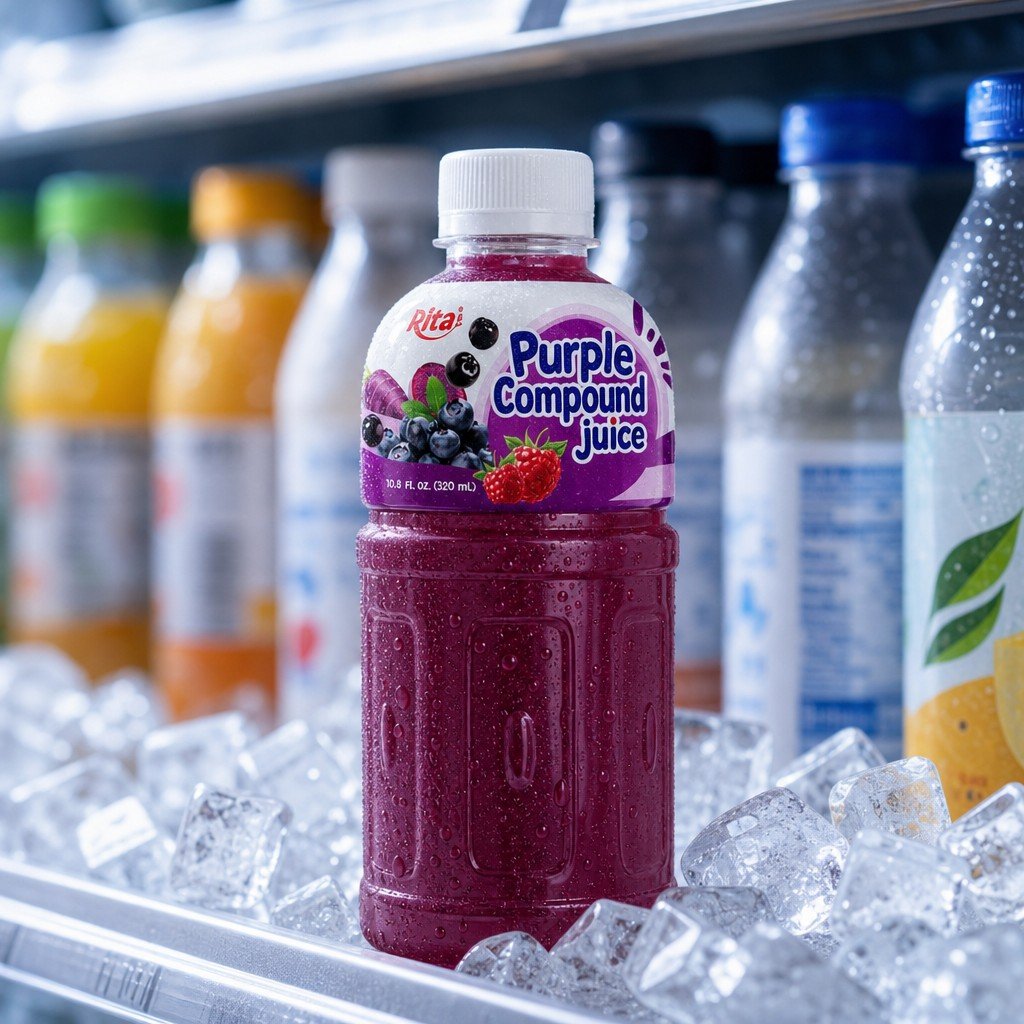
The 320ml PET bottle is cylindrical, nestable in standard trays and light enough to keep total shipped weight low relative to glass alternatives. PET's impact resistance also reduces breakage claims during multi-drop deliveries to convenience stores, where handling is fast and storage space is tight. Because the bottle cools rapidly, retailers can move product from ambient storage into chillers on short notice, supporting impulse purchase without holding pre-chilled inventory. Recyclability adds a further argument in markets where packaging recovery schemes and extended producer responsibility rules continue to tighten, and where buyers increasingly ask for material declarations during supplier qualification.
Case Formats and Shelf Economics
Shoppers notice color before they read a label, and purple remains underused in European juice aisles dominated by orange, apple and red berry tones.
A vivid pack earns the extra second of attention that decides an unplanned purchase, and it does so without requiring a promotional price. Case design follows the same logic: a compact bottle allows tighter case counts per pallet layer, which stabilizes freight cost per unit and simplifies replenishment planning for chains operating small-format stores.
It also keeps the product within reach of younger consumers who buy single bottles rather than multipacks, a segment that drives a meaningful share of convenience volume. For category managers, the combination of distinctive color, manageable case economics and a format shoppers already carry makes the drink a low-friction addition to an existing juice lineup rather than a fixture that demands new equipment or staff retraining.
Certified Manufacturing and Export Scale behind the Bottle
Scale and certification decide whether a sample ever becomes a shipment.
RITA Food and Drink Co., Ltd was established in 2004 and has grown into a leading Vietnamese OEM/ODM beverage manufacturer supplying brands in more than 180 countries. The company operates over 50 automated production lines and moves more than 1,200 containers per month, a volume that supports large repeat orders as well as smaller trial runs for new listings. Its portfolio spans tropical fruit juices, coconut products, functional drinks and energy drinks packed in aluminum cans, glass bottles, PET and PP formats, giving buyers room to expand a range without changing partners.
Quality systems are the second half of the supplier approval conversation, and the documentation European technical teams request is already in place:
- BRC and FSSC 22000 food safety certification
- Halal Jakim and Halal HCA-GCC certification
- Kosher certification for dual-distribution channels
- ISO, GMP and HACCP production controls
- SMETA social compliance audit
Private Label Programs for European Buyers
For companies planning fruit juice exports to Europe, the practical question is who handles formulation, artwork and compliance in one accountable relationship.
That is where RITA beverage OEM and ODM services come in: custom formulations, label development, format selection and private label packaging are managed through a single partner with export experience across more than 200 countries and territories. Documentation, labeling variants and shipping routes are already established for most destination markets, which shortens the distance between a signed contract and a first container. Distributors can review the wider fruit juice products range or request samples of the purple compound juice in its 320ml PET format to begin technical evaluation with their own quality teams.
Where Purple Compound Juice Fits in European Category Strategy
The opportunity sits at the intersection of color, format and channel.
In Germany and France, grocery buyers continue to look for juice variants that justify shelf space without cannibalizing core listings, and a distinct purple pack with a blended fruit-and-vegetable recipe offers a clear point of difference. Dutch and Spanish convenience operators favor formats that move quickly in chillers, which is exactly where the 320ml bottle performs best. In Italy, the drink can sit alongside coffee-bar service as a chilled option or serve as a mocktail base, while Nordic retailers tend to weigh packaging recovery and logistics density as closely as taste. A single specification that satisfies all of these readings reduces the number of variants a distributor has to carry.
| Pack format | Primary European channel | Supply chain note |
|---|---|---|
| 320ml PET bottle | Convenience chillers, cafes, travel retail | Lightweight, rapid cooling, high facings per metre |
| Aluminum can | Multipack grocery, events | Stackable, opaque to light, compact pallet density |
| Glass bottle | Premium grocery, horeca | Higher shipped weight, breakage handling |
| Large PET bottle | Take-home grocery | Family consumption, fewer facings per shelf metre |
Format comparison for European retail channels, based on RITA export experience.
Wholesale distributors gain most from a format that already fits their existing routes: a bottle that slots into current trays, chillers and case stacks requires no new equipment. That practicality, paired with a color shoppers do not see every day, is why the purple compound juice is being evaluated for listings from Hamburg to Helsinki.
Supply chains reward products that ask little of them.
As European buyers reopen contracts, defend margins against taxation pressure and chase differentiation in crowded aisles, the combination of a compact recyclable bottle, a layered taste profile and certified export-scale manufacturing becomes difficult to overlook. The purple compound juice 320ml PET bottle is a compact case study in how a single well-specified product can serve several markets, several channels and several commercial models at the same time.
Frequently Asked Questions
What is RITA Purple Compound Juice 320ml PET bottle?
It is a ready-to-drink purple compound juice filled in a 320ml recyclable PET bottle with a white screw cap. The drink blends blueberries, raspberries and purple carrots for a layered sweet, tart and earthy taste, and it is supplied to retail, food service and wholesale channels across international markets.
Which European markets can import this purple compound juice?
RITA exports to more than 200 countries and territories, with established routes into Germany, France, the Netherlands, Italy, Spain, Sweden, Norway, Denmark and Finland. Documentation, labeling variants and case configurations are adapted to each destination during order planning.
Can the product be produced under a private label?
Yes. RITA operates OEM and ODM programs covering custom formulations, label design and packaging selection across PET, PP, aluminum can and glass formats, so European distributors can launch a branded version of the juice without investing in their own production capacity.
What certifications support the manufacturing of this juice?
Production is carried out under BRC, FSSC 22000, Halal Jakim, Halal HCA-GCC, Kosher, ISO, GMP, HACCP and SMETA certifications, covering the quality and social compliance documentation typically requested during supplier approval in European retail.
How does the 320ml PET format support retail logistics?
The compact bottle is lightweight, stacks efficiently in trays and pallets, cools quickly in chillers and fits standard convenience-store fixtures, which keeps handling simple and allows more facings per linear metre of shelf space.
Related news items:
Newer news items:
- Six Days Across Yunnan: The Rita Beverage 2026 Appreciation Trip to Dali, Lijiang, and Shangrila - 07/11/2026 04:14
- Consumer Shift Toward High-Protein RTD Coffee Reshapes Beverage Aisles - 05/11/2026 22:35
- Beyond the Workplace: How Rita Beverage Builds a Stronger Team Through Shared Experiences - 04/11/2026 23:50
- Mango Coconut Water Meets 15g Protein in RITA's New 325ml Can - 03/11/2026 22:28
- Ready for Takeoff: Rita Beverage Prepares for the 2026 Employee Appreciation Trip to China - 02/11/2026 22:48
Older news items:
- Rita Beverage Halloween 2026: Tricks, Treats, and Team Spirit in the Office - 31/10/2026 00:46
- Bird's Nest Fugus Lychee Rose Juice Eyes European Export Growth - 29/10/2026 22:54
- Coconut Water With Chocolate Flavor Drives Beverage Innovation - 27/10/2026 21:34
- Yuzu Electrolyte Water Emerges as a Low-Sugar Hydration Innovation - 25/10/2026 18:50
- Rita at SIAL Paris 2026: Vietnamese Beverage Innovation on the International Stage - 23/10/2026 00:20
 084 274 3784788

 No. 8, Thong Nhat Boulevard, Song Than 2 Industrial Park, Di An Ward, HCMC, Vietnam.