
Ginger Milk Tea Meets European Regulatory Standards in the RTD Beverage Space

The European ready-to-drink beverage market is entering a phase of accelerated growth, yet the pathway to store shelves is anything but straightforward. For manufacturers looking to introduce novel flavor profiles such as ready-to-drink ginger milk tea, the regulatory environment across the European Union presents a complex web of compliance requirements that must be addressed long before a single can reaches a consumer.
From food safety certifications to multilingual labeling, every step of the process demands meticulous attention to detail. The convergence of shifting consumer preferences toward adventurous flavor combinations and the tightening of import regulations has made regulatory compliance a defining factor for brands seeking to establish a foothold in one of the world's most demanding beverage markets.
Against this backdrop, RITA Food and Drink Co., Ltd — a Vietnamese beverage manufacturer with over two decades of export experience — has positioned itself as a company equipped to navigate these challenges. With its portfolio expanding to include products such as the Ready-to-Drink Ginger Milk Tea with Peach Flavor, the company is demonstrating how Asian beverage innovation can align with European regulatory expectations.
Key Takeaways
- European RTD beverage regulations require comprehensive food safety certifications, multilingual labeling, and full ingredient traceability for market entry.
- Shelf-stable packaging in aluminum cans offers significant regulatory and logistics advantages for imported beverages entering the EU.
- RITA Food and Drink Co., Ltd holds BRC, FSSC 22000, ISO, HACCP, and other internationally recognized certifications required for European distribution.
- The combination of ginger, milk tea, and peach flavoring positions the product at the intersection of functional ingredient trends and traditional tea culture.
- Germany, France, the Netherlands, Italy, Spain, and the Nordic countries represent key entry points for RTD beverages in the European market.
Navigating European RTD Beverage Regulations
For any beverage product entering the European market, regulatory compliance is not optional — it is the foundation upon which every distribution decision rests. The European Union's General Food Law Regulation (EC) No. 178/2002 establishes the legal framework for food safety, requiring that all food and beverage products placed on the EU market are safe, properly labeled, and fully traceable from production to consumer. For manufacturers outside the EU, this means that export-ready products must meet these standards before they even leave the factory floor.
The regulatory burden is particularly significant for products that combine multiple ingredient categories, such as ready-to-drink ginger milk tea. A product blending tea, dairy-derived ingredients, fruit flavoring, and botanical extracts must satisfy the requirements of several EU directives simultaneously, including the Food Information to Consumers Regulation (EU) No. 1169/2011, the Hygiene Package, and applicable national legislation in each target country.
Global Market & Export Overview
The ginger milk tea and RTD milk tea category has experienced robust growth globally, with shipments nearly doubling in 2026 compared to 2025. Below is a snapshot of the latest trade trends based on real import–export data.
Annual Trade Trend (2025 vs 2026)
| Year | Shipments | Total Value (USD) | Total Weight (kg) | Total Quantity (units) |
|---|---|---|---|---|
| 2025 | 75 | 33,258 | 864,946 | 113,178 |
| 2026 | 141 | 59,855 | 1,118,806 | 146,578 |
| YoY Change | +88% | +80% | +29.3% | +29.5% |
Data source: Tradesparq Trade Data (tradesparq.com)
Top Origin (Supplier) Countries
| Country | Shipments | Share of Shipments | Value (USD) | Weight (kg) |
|---|---|---|---|---|
| Vietnam | 68 | 31.5% | 4,168 | 397,015 |
| South Korea | 37 | 17.1% | 16,940 | 323,685 |
| China | 16 | 7.4% | 6 | 230,874 |
| India | 14 | 6.5% | 5,394 | 80,125 |
| Malaysia | 14 | 6.5% | 17,945 | 58,610 |
Data source: Tradesparq Trade Data (tradesparq.com)
Top Destination (Buyer) Markets
| Country | Shipments | Share of Shipments | Weight (kg) | Quantity (units) |
|---|---|---|---|---|
| United States | 149 | 69.0% | 1,903,006 | 231,488 |
| Indonesia | 21 | 9.7% | 2,703 | 8,002 |
| Vietnam | 17 | 7.9% | 0 | 1,065 |
| Bahamas | 7 | 3.2% | 26,465 | 41 |
| Philippines | 5 | 2.3% | 2,040 | 7,251 |
Data source: Tradesparq Trade Data (tradesparq.com)
Main HS Codes by Trade Volume
| HS Code | Description | Shipments | Value (USD) |
|---|---|---|---|
| 210120 | Tea/mate extracts, essences, concentrates and preparations (core raw material) | 29 | 41,437 |
| 121190 | Plant materials for flavouring / health use | 23 | 3,008 |
| 210690 | Food preparations, n.e.s. | 12 | 54 |
| 190590 | Other bakers' wares | 9 | 38,605 |
Data source: Tradesparq Trade Data (tradesparq.com)
Monthly Seasonal Pattern
The trade data reveals a clear seasonal pattern: peak activity occurs during cold-season months, with December 2025 recording the highest single-month volume at 29 shipments and 389,135 kg, followed by May 2026 with 26 shipments. Conversely, summer months represent the off-season, with August 2025 (4 shipments) and August 2026 (9 shipments) at the low end. November 2025 and May 2026 also saw the broadest participation, with 17–19 distinct buyers and suppliers active each month.
Data source: Tradesparq Trade Data (tradesparq.com)
The ginger milk tea market is expanding rapidly — shipments surged 88% and trade value rose 80% in 2026 compared to 2025. Vietnam dominates as the largest origin country, accounting for 31.5% of all global shipments, followed by South Korea at 17.1%. On the demand side, the United States is overwhelmingly the top destination, absorbing 69.0% of total shipments by volume — a clear signal of strong consumer demand in the American RTD tea market. Indonesia (9.7%) and Vietnam itself (7.9%) round out the top three buyer markets. The data underscores that while production is concentrated in Southeast and East Asia, the primary commercial opportunity lies in North America.
Notably, Vietnam appears as both a major exporter and a buyer, reflecting its dual role as a production hub and a re-export gateway. HS code 210120 (tea extracts and preparations) leads trade activity with 29 shipments valued at $41,437, confirming that the core product category — tea-based RTD beverages — drives the majority of value in this market.
Labeling and Allergen Declarations
One of the most critical compliance areas for imported RTD beverages is labeling. The EU's Food Information to Consumers regulation mandates that product labels include a complete ingredient list in the official language of the destination country, a nutrition declaration per 100 ml, allergen highlighting in bold or capital letters, and the name and address of the responsible operator within the EU. For a product like RITA's Ready-to-Drink Ginger Milk Tea with Peach Flavor, which contains milk-derived ingredients and flavor compounds, accurate allergen labeling is especially important.
Germany, for instance, requires labeling in German, while France demands French-language packaging. In the Nordic countries, local language requirements vary — Sweden requires Swedish, Finland requires Finnish and Swedish, and Denmark requires Danish. The Netherlands and Italy follow Dutch and Italian respectively, while Spain mandates Spanish. This multilingual labeling requirement adds a layer of complexity that only experienced manufacturers with established compliance teams can manage efficiently.
Nutritional Information and Ingredient Sourcing
Beyond language, EU regulations require detailed nutritional information presented in a standardized tabular format. This includes energy value in kilojoules and kilocalories, fat content, saturates, carbohydrate content, sugars, protein, and salt — all expressed per 100 ml and, optionally, per portion. For a ready-to-drink ginger milk tea product, the manufacturer must ensure that nutritional data is accurate, verifiable, and consistent across production batches. Ingredient sourcing documentation must also be maintained to satisfy EU traceability requirements, which demand that every component of the product can be traced back to its origin.
Shelf Stability and Cold Chain Logistics
European distribution networks for imported beverages rely heavily on shelf-stable packaging that can withstand extended transit times and variable storage conditions. Aluminum cans have emerged as the preferred format for many RTD products entering the EU market, offering superior barrier properties that protect flavor integrity, extended shelf life without refrigeration, full recyclability aligned with EU circular economy goals, and reduced packaging weight that lowers shipping costs per unit.
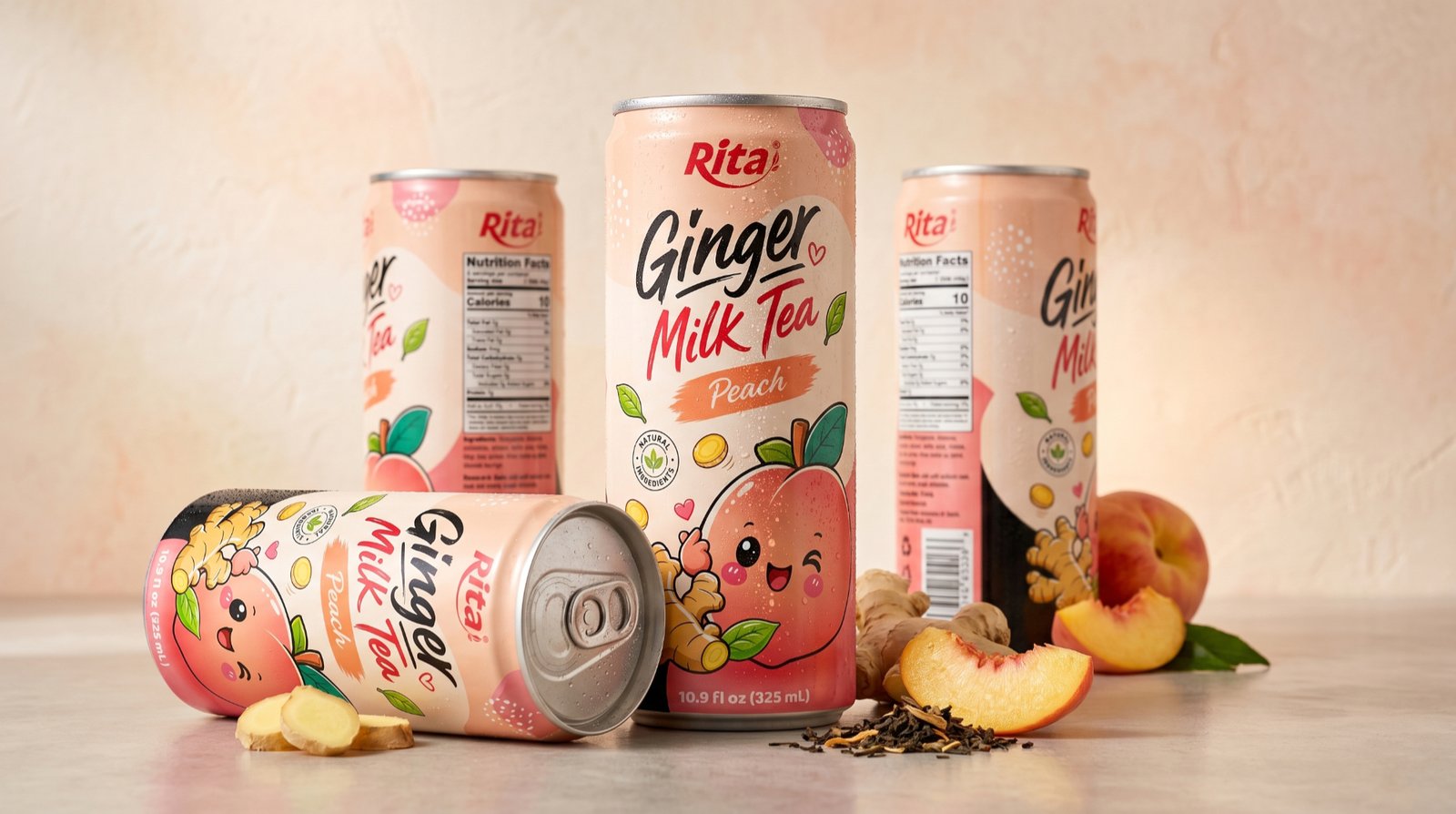
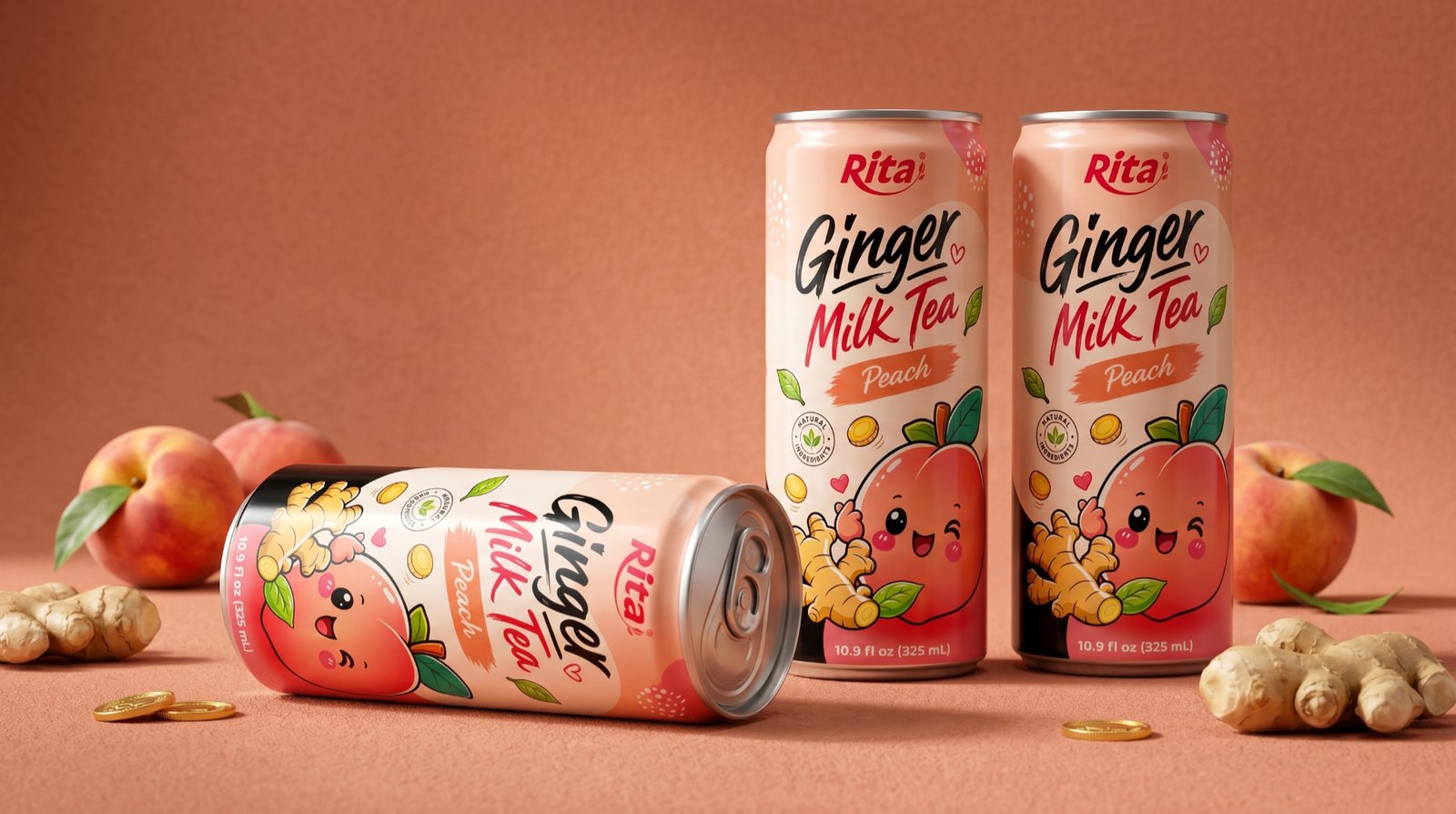
The 325 ml aluminum can format used for RITA's ginger milk tea is designed with these logistical realities in mind. The can's sealed construction protects the beverage's creamy milk tea base, sweet peach notes, and gentle ginger warmth from light and oxygen degradation during the weeks-long sea transit from Southeast Asia to European ports.
Cold Chain vs. Ambient Distribution
Unlike chilled beverages that require an unbroken cold chain from production to retail shelf, shelf-stable RTD products in aluminum cans can be distributed through standard ambient logistics networks. This represents a significant cost advantage for importers and distributors, as it eliminates the need for temperature-controlled warehousing and refrigerated transport. For European retailers managing tight margin structures, the ability to stock ambient RTD beverages in conventional shelf space rather than refrigerated displays is a compelling proposition.
Understanding European Consumer Expectations
European consumers are among the most discerning in the global beverage market. Their expectations extend beyond taste to encompass packaging sustainability, brand transparency, ingredient quality, and alignment with cultural beverage traditions. The RTD tea segment, in particular, has seen steady growth across Germany, France, and the Nordic countries, where consumers are increasingly open to flavor innovations that blend familiar tea profiles with unexpected twists.
The combination of ginger, milk tea, and peach in a single product taps into several overlapping consumer trends. Ginger has maintained its position as a widely recognized ingredient across European markets, valued for its distinctive flavor profile. Peach, meanwhile, remains one of the most popular fruit flavors in the European RTD category, particularly in southern European markets such as Italy and Spain. The milk tea base connects with the growing boba and milk tea culture that has expanded from Asian diaspora communities into mainstream European consumption patterns.
Flavor Innovation in a Regulated Market
Introducing innovative flavor combinations within the EU regulatory framework requires careful formulation and testing. Novel food regulations under Regulation (EU) 2015/2283 may apply to certain ingredients or preparation methods not traditionally used in European food products. Manufacturers must submit novel food applications to the European Food Safety Authority (EFSA) for any ingredient that does not have a documented history of safe use within the EU before May 1997. For a ready-to-drink ginger milk tea, the key ingredients — tea, milk derivatives, peach flavoring, and ginger extract — all have established histories in European food consumption, which simplifies the regulatory pathway considerably.
From Farm to Factory — Raw Material Sourcing
The quality of any beverage begins with its raw materials, and the Mekong Delta region of Vietnam has established itself as one of Asia's most productive agricultural zones. RITA sources its key ingredients from this fertile region, where the combination of tropical climate, rich alluvial soil, and generations of farming expertise creates ideal conditions for cultivating the raw materials that go into the company's beverage portfolio. The Mekong Delta's role as a high-quality raw ingredient source for RITA is a critical part of the company's supply chain, ensuring consistent quality and traceability from field to production facility.
For ginger-based beverages specifically, the sourcing process involves selecting varieties with the right balance of aromatic compounds and flavor intensity. The ginger used in RITA's products is selected for its ability to deliver a gentle, lingering warmth that complements rather than overpowers the creamy milk tea and sweet peach notes. This careful ingredient selection is what allows the product to achieve a harmonious flavor profile that feels both familiar and distinctive.
https://www.youtube.com/watch?v=jiBixXjeG8A
RITA's Manufacturing and Certification Infrastructure
For a Vietnamese manufacturer to export beverages to the European Union, the certification portfolio must be comprehensive and current. RITA Food and Drink Co., Ltd, established in 2004, has built a manufacturing infrastructure that addresses these requirements through a combination of international certifications, automated production capabilities, and dedicated quality assurance protocols.
The company holds BRC (British Retail Consortium) certification, which is widely recognized as a baseline requirement for food products entering UK and EU retail channels. FSSC 22000 certification provides the food safety management system framework required by many European retailers and distributors. Additional certifications including ISO, GMP, HACCP, and SMETA audit compliance ensure that RITA's production facilities meet the operational and ethical standards expected by European procurement teams.
OEM and Private Label Capabilities
One of RITA's core value propositions for European market entry is its OEM manufacturing service, which allows European brands and importers to develop custom beverage products using RITA's production infrastructure. With over 50 automated production lines and a capacity to export more than 1,200 containers per month, the company can scale production to meet the demands of European distribution networks while maintaining consistent quality standards across batches.
For importers considering the RITA Ready-to-Drink Ginger Milk Tea as a branded product, the company also offers ODM (Original Design Manufacturing) services, where RITA's R&D team develops formulations and packaging designs based on the importer's specifications. This dual capability — OEM for brands with existing formulations and ODM for those seeking turnkey solutions — provides European importers with flexibility in how they bring RTD products to market.
Certification Comparison for EU Market Entry
| Certification | Purpose | EU Market Relevance |
|---|---|---|
| BRC | Global Food Safety Standard | Required by most UK/EU retailers |
| FSSC 22000 | Food Safety Management System | Recognized by GFSI, accepted across EU |
| ISO 22000 | Food Safety Management | International standard, EU-accepted |
| HACCP | Hazard Analysis & Critical Control Points | EU regulatory requirement |
| GMP | Good Manufacturing Practice | Required for food production facilities |
| Halal / Kosher | Religious dietary compliance | Relevant for diverse EU demographics |
| SMETA | Ethical Trade Audit | Increasingly required by EU retailers |
Strategic Market Entry Across European Countries
European market entry for RTD beverages is not a monolithic strategy — each country presents distinct regulatory, distribution, and consumer dynamics that require tailored approaches. Germany, as Europe's largest beverage market, offers scale but demands rigorous compliance with the Lebensmittelrecht (German Food and Feed Code) and strong relationships with established distribution networks. France requires adherence toDGCCRF regulations and localization that extends beyond language to packaging aesthetics and placement.
The Netherlands serves as a strategic logistics hub, with Rotterdam functioning as the primary gateway for imported goods entering the EU. Italy and Spain represent markets where fruit-flavored beverages have strong cultural resonance, and where the milk tea category is still in its early growth phase — presenting an opportunity for first movers. The Nordic countries — Sweden, Norway, Denmark, and Finland — combine high per-capita spending on beverages with strict environmental regulations that favor fully recyclable packaging formats like aluminum cans.
Distribution Channel Considerations
The choice of distribution channel varies significantly across these markets. In Germany and the Netherlands, discount retail chains hold substantial market share, requiring products to meet specific price-point and volume expectations. In France and Italy, specialty beverage retailers and gourmet food stores offer premium placement opportunities for innovative products. The Nordic market favors health-conscious positioning and sustainable packaging narratives, which aligns well with the clean ingredient profile and recyclable can format of a product like RITA's ready-to-drink ginger milk tea.
Practical Steps for European Importers
For European distributors and importers evaluating RTD beverage products from Asian manufacturers, the compliance checklist typically includes verifying that the manufacturer holds GFSI-recognized certifications, confirming that product formulations comply with EU additive and flavor regulations, ensuring that multilingual labeling can be produced in-house or through approved partners, validating shelf life claims through accelerated stability testing, and confirming that allergen declarations meet the specific requirements of each target country.
RITA's experience exporting to over 200 countries and territories means that these compliance steps are not unfamiliar territory. The company's established processes for producing export-ready documentation, adapting packaging for different markets, and maintaining batch-to-batch consistency provide a level of reliability that European importers require when sourcing from overseas manufacturers.
Frequently Asked Questions
What certifications does RITA hold for exporting beverages to Europe?
RITA Food and Drink Co., Ltd holds BRC, FSSC 22000, ISO, GMP, HACCP, Halal (Jakim and HCA-GCC), Kosher, and SMETA certifications. These internationally recognized credentials are essential for meeting European food safety and ethical trade requirements.
Is the aluminum can format suitable for European distribution?
Yes. The 325 ml aluminum can is fully recyclable, shelf-stable, and lightweight — all characteristics that align with European distribution logistics and the EU's circular economy packaging goals. Aluminum cans also provide excellent barrier properties that protect flavor integrity during extended transit and storage.
Does the ginger milk tea require refrigeration?
No. The product is designed as a shelf-stable RTD beverage, meaning it does not require cold chain logistics for distribution. This ambient distribution capability significantly reduces logistics costs and simplifies retail placement across European markets.
Can European brands use RITA's OEM or ODM services for custom formulations?
RITA offers both OEM (Original Equipment Manufacturing) and ODM (Original Design Manufacturing) services. OEM allows brands to produce their existing formulations using RITA's facilities, while ODM provides turnkey solutions where RITA's R&D team develops formulations and packaging based on the client's specifications.
What is the minimum order quantity for exporting to European markets?
Minimum order quantities vary by product format and packaging specifications. RITA's export capacity exceeds 1,200 containers per month across 50+ automated production lines, allowing the company to accommodate both trial orders for market testing and large-volume production runs for established distribution networks.
Related news items:
Newer news items:
- How Yuzu Electrolyte Water Is Reshaping Consumer Hydration Choices - 29/09/2026 07:21
- Rita Celebrates Mid-Autumn Festival with Employees and Partners - 23/09/2026 08:04
- Rita Visits a Guava Farm in Dong Thap to Explore Fresh Fruit Sourcing - 22/09/2026 02:46
- Navigating European Beverage Regulations — Sea Moss Coconut Water Enters a Complex Compliance Landscape - 18/09/2026 09:18
- Sustainability-Driven Coconut Water With Watermelon Juice Redefines Modern Beverage Standards - 18/09/2026 09:04
Older news items:
- 100 Natural Peach Juice Drink Opens New Export Opportunities Across Europe - 17/09/2026 07:37
- Orange Cream Prebiotic Soda Gains Traction in European Sparkling Market - 17/09/2026 07:20
- Real Lemon Slices in Cans Define the Future of Clean-Label Sparkling Water - 11/09/2026 08:22
- Zero-Sugar Sparkling Water with Real Fruit Slices Gains Ground - 11/09/2026 07:52
- Navigating Regulatory Pathways for Seed-Based Beverages in Europe - 11/09/2026 04:10
 084 274 3784788
 No. 8, Thong Nhat Boulevard, Song Than 2 Industrial Park, Di An Ward, HCMC, Vietnam.