
Vietnam's Yuzu Electrolyte Water Targets Europe's Low-Sugar Aisle

Yuzu electrolyte water is moving beyond the specialty shelf into Europe's mainstream low-sugar hydration category, and the supply chains behind that expansion are now as important to buyers as the liquid itself. Vietnamese manufacturer RITA has placed its 325ml slim-can format in front of importers and retail decision-makers across Germany, France, the Netherlands, Italy, Spain and the Nordics, positioning the drink as a lighter, citrus-forward alternative in an increasingly crowded carbonated and hydration aisle.
What makes the case interesting from a sourcing perspective is not only the flavor. It is the packaging format, the mineral composition, the low-sugar specification, the certification package and the export infrastructure required to move consistent volumes into multiple European distribution networks within the same season.
Key Takeaways
- European low-sugar hydration formats are expanding across retail, foodservice and convenience channels in Germany, France, Italy, Spain and the Nordics.
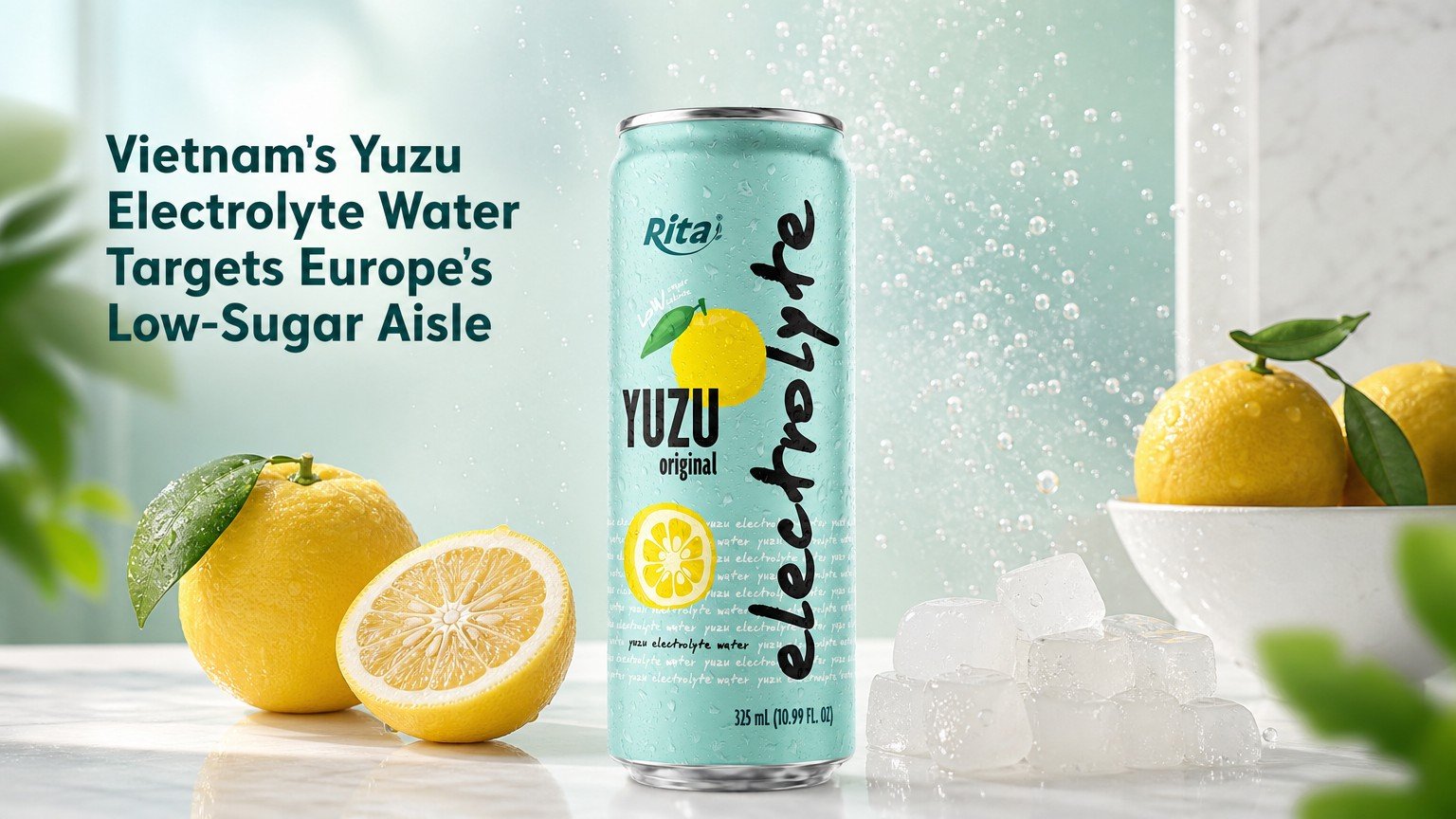
- RITA's yuzu electrolyte water uses a 325ml slim aluminum can built for portable consumption and efficient pallet handling.
- The formula pairs carbonated water with electrolyte minerals at a low sugar content, with a Brix range of 12-14 and yuzu as the dominant flavor note.
- Behind the product sits an OEM and ODM manufacturer exporting to more than 200 countries and territories, under internationally recognised certification schemes.
- Private label buyers can review specifications, packaging formats and export terms through RITA's product and catalog pages.
Yuzu Electrolyte Water and Europe's Shifting Hydration Shelf
European retailers are rebuilding their chilled and ambient hydration sets around lower-sugar formats, and citrus-forward drinks are among the fastest-moving groups in that rebuild.
The Low-Sugar Hydration Category in Germany, France and the Nordics
Germany has traditionally been the proving ground for new beverage formats in Europe, given the reach of both discount and full-service retail networks and a consumer base accustomed to reading detailed product information. Within that environment, low-sugar beverages are increasingly displayed as a mainstream tier rather than a niche segment, which changes how importers evaluate new entrants. A product that arrives with a clear sugar specification, a distinct flavor identity and a recognizable format has a stronger shelf-positioning argument than one that competes only on price.
France and Italy bring different expectations. Both markets have a long association with citrus and sparkling water traditions, which gives a yuzu-based product a familiar cultural reference point even when the specific fruit is not part of everyday local consumption. Buyers in these markets tend to emphasize flavor credibility and drinkability, and they respond well to citrus varieties that can be described precisely rather than generically.
In Sweden, Norway, Denmark and Finland, portability and straightforward ingredient panels matter as much as flavor. Products are frequently consumed during commuting, training sessions and workdays rather than as table beverages, which favors compact formats with light, non-cloying taste profiles. The 325ml aluminum can format aligns closely with that consumption pattern.
Slim-Format Aluminum Cans and Retail Logistics
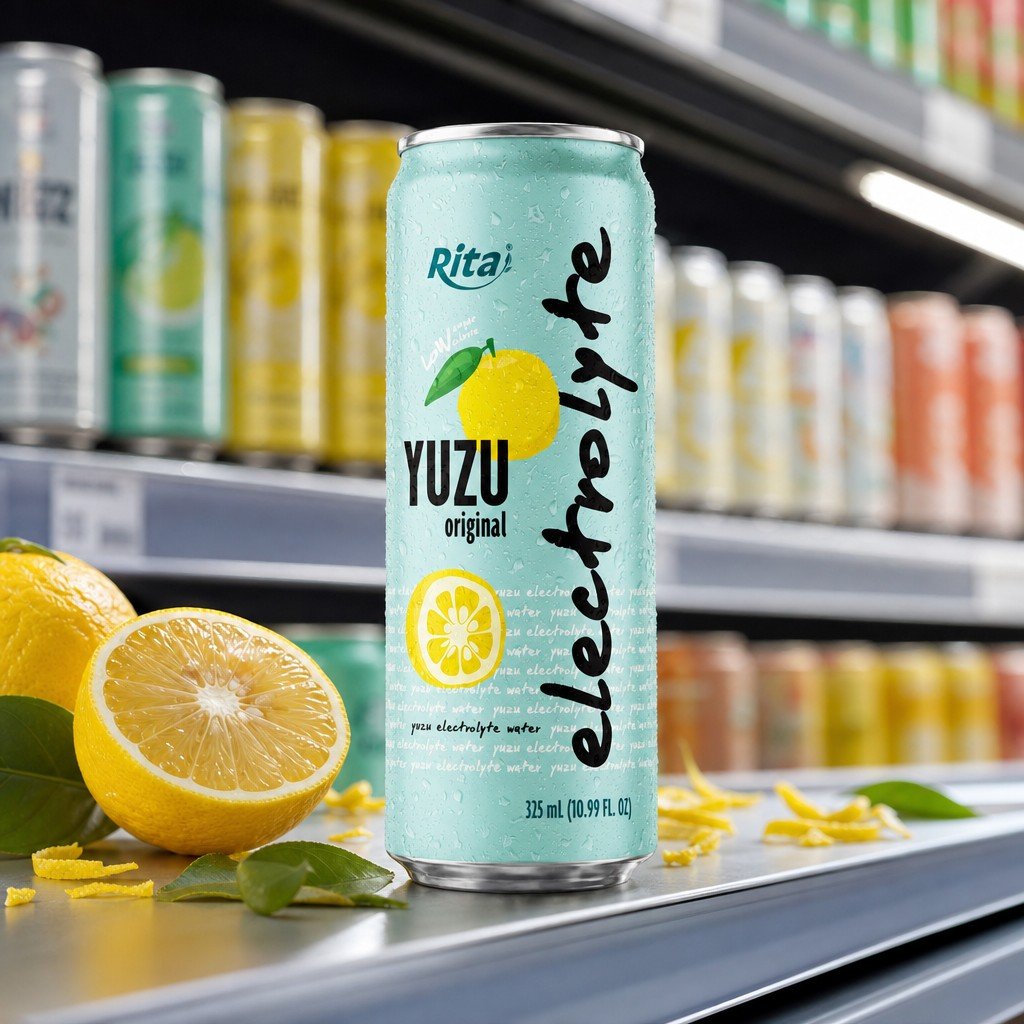
The 325ml slim can is not a random choice in this category. Slim profiles take up more linear shelf space per unit while reading as more contemporary than standard 330ml cylinders, and they handle well in coolers, vending machines, foodservice counters and transport packaging. For a low-sugar hydration beverage, the format signals a lighter product before the can is even opened.
Aluminum also carries practical advantages across a fragmented distribution landscape. It is lightweight relative to glass, offers consistent barrier performance, and supports rapid cooling in chilled retail environments. For importers managing storage across multiple countries, standardized can dimensions simplify stacking, pallet configuration and warehouse planning, which in turn reduces variability in landed cost.
From Citrus Orchards to the Can — Mapping the Yuzu Supply Chain
Yuzu is a small, intensely aromatic citrus fruit, and that aroma is the reason it travels well in beverage formats where volume is small but flavor expectations are high. Sourcing it consistently, however, requires a supply chain built around seasonal availability, cold-chain discipline and precise blending.
Citrus raw materials are inherently variable. Fruit harvested at different points of ripeness delivers different acidity and aroma intensity, so manufacturers that build consistent beverage specifications normally work with traceable lots and standardised extraction or flavoring processes rather than relying on a single fruit intake window. The goal in this category is repeatability: the third can should taste like the first, whether it is produced in March or November.
The company documents its sourcing model through a series of regional production stories, including the orange farm behind RITA's citrus sourcing program, which illustrates how citrus raw materials are evaluated from cultivation through to finished beverage production.
RITA also publishes visual material of that journey, which gives buyers and technical teams a practical view of how fruit selection and handling feed into the final drink specification: https://www.youtube.com/watch?v=l-x6Vxb_ONQ
For European importers, this kind of traceability documentation is increasingly part of supplier due diligence rather than an optional extra. Retailers and distributors want to understand where raw materials come from, how lots are approved and how consistency is maintained across production runs.
RITA's Export Infrastructure Behind the 325ml Format
RITA Food and Drink Co., Ltd. was established in 2004 and operates as an OEM and ODM beverage manufacturer serving export markets across Asia, Europe, the Middle East, Africa and the Americas.
The scale behind that statement matters for European buyers. The company runs more than 50 automated production lines and exports in the order of 1,200 containers per month, while supplying brands in more than 180 countries and with shipments reaching more than 200 countries and territories. The full 325ml yuzu electrolyte water product specification sits within this export framework, which means formulation, filling format and labeling can be aligned to individual buyer requirements rather than limited to a fixed stock catalogue.
Certification Framework for European Entry
European distribution rarely starts with the beverage itself. It starts with documentation. The manufacturer holds a broad certification package that covers food safety management, quality systems, sourcing standards and labor conditions, which shortens the onboarding process for importers and retail groups.
- BRC for global food safety standards
- FSSC 22000 for food safety system certification
- Halal Jakim and Halal HCA-GCC certifications
- Kosher certification for wider market eligibility
- ISO and GMP systems for quality management
- HACCP for hazard analysis and control planning
- SMETA for social and labor compliance auditing
Together, these certifications allow the same production infrastructure to serve buyers with different regulatory expectations, which is a meaningful advantage in a region where label requirements, allergen rules and retailer standards vary noticeably between Germany, France, Italy, Spain and the Nordic markets.
Formulation, Taste Profile and Consumer Positioning
The liquid is engineered around a specific drinking moment: light, refreshing and easy to consume in compact volumes.
The base is carbonated water, which delivers a gentle effervescence rather than the heavier carbonation level found in many sodas. Electrolyte minerals are included in the formulation, and the sugar content is kept low, with a Brix reading in the 12-14 range. The result is a drink that reads as restrained on the palate, where yuzu's aromatic character is the main event rather than sweetness.
How Yuzu Differentiates the Category
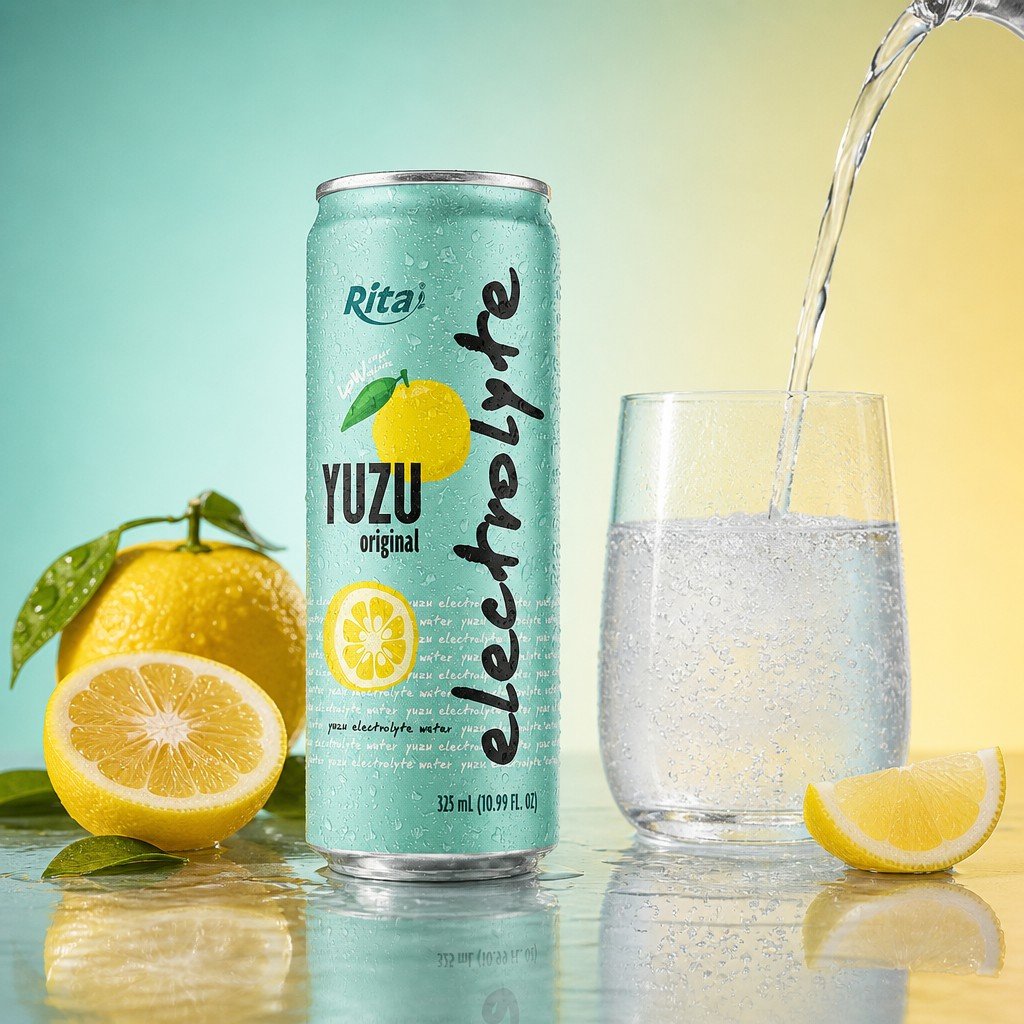
The yuzu electrolyte water is marketed in a 325ml aluminum slim can with a minty teal palette and yuzu fruit graphics, a visual language that reads as fresh and light before the product is tasted. Yuzu flavor descriptors typically include floral citrus notes, a sharper aromatic top note and less obvious sweetness than standard orange or lemon profiles, which gives the drink a more distinctive taste character on shelf and on the palate.
That distinction matters commercially because the electrolyte water segment is becoming crowded. Several beverage categories now sit in the same aisle under similar color language, which means flavor identity and format clarity do more work than packaging alone.
| Attribute | Yuzu Electrolyte Water 325ml | Standard Citrus Electrolyte Water | Conventional Citrus Soda |
|---|---|---|---|
| Primary flavor | Yuzu, aromatic citrus | Orange or lemon blend | Orange or cola base |
| Sugar positioning | Low, Brix 12-14 | Mid to high | High |
| Carbonation | Light effervescence | Moderate | High |
| Format | 325ml slim aluminum can | 330-500ml cans or PET | 330ml standard can |
| Positioning | Portability, citrus differentiation | Functional hydration | Refreshment, indulgence |
From a consumer-experience perspective, the combination of a light mineral profile, low sugar and an aromatic citrus note gives the drink a broader usage window than a heavy soda. It is positioned in retail and foodservice settings where buyers are looking for a hydration drink 325ml that can be consumed cold throughout a workday, a commute or a light training routine.
Private Label and OEM Opportunities for European Buyers
For European importers and private label brands, the practical question is no longer whether yuzu electrolyte water can be produced at scale — it is how closely a supplier can adapt the format, flavor balance and labeling to a specific market.
RITA operates as an OEM beverage manufacturer with in-house R&D, meaning buyers can adjust sugar levels, mineral profiles, carbonation and flavor intensity within an existing validated process rather than building a formulation from zero. That flexibility is particularly relevant in Europe, where a single product may need different nutrition panels, language versions and retailer-specific pack sizes across Germany, France, the Netherlands, Italy, Spain and the Nordic markets.
Packaging options extend beyond the 325ml aluminum can. The company also fills PET bottles, glass bottles and PP containers, which allows buyers to test the same flavor profile in different channels — can formats for chilled retail and convenience, for example, or larger formats where ambient storage is more practical. Buyers exploring adjacent ranges can also review RITA's soft drinks portfolio to understand how the yuzu format fits into a broader beverage line, alongside the carbonated drink catalog for additional carbonated options.
Commercially, the supply proposition is built around repeatable output. With more than 50 automated production lines and monthly export volumes in the order of 1,200 containers, the manufacturer can support multi-country distribution without forcing importers into single-order commitments tied to a production window. For brands considering private label beverages in the hydration segment, that combination of formulation access, certified quality systems and export scale is what turns a flavor idea into a shelf-ready range.
Frequently Asked Questions
What is yuzu electrolyte water?
It is a carbonated, low-sugar drink combining electrolyte minerals with the aromatic flavor of yuzu citrus, packaged in a 325ml aluminum slim can and developed by RITA Food and Drink Co., Ltd. for export markets.
What is the sugar content of the 325ml format?
The formula is specified at a low sugar level with a Brix range of 12-14, using carbonated water as the base and keeping sweetness restrained so that the citrus aroma remains the dominant taste note.
Which European markets is the product aimed at?
The primary target markets are Germany, France, the Netherlands, Italy, Spain and the Nordics — Sweden, Norway, Denmark and Finland — where demand for lower-sugar, portable beverage formats has been expanding across retail and foodservice channels.
Does RITA offer private label or OEM production for this drink?
Yes. The company operates as an OEM and ODM manufacturer with in-house R&D, more than 50 automated production lines and exports to more than 200 countries and territories, allowing buyers to adjust formulation, flavor intensity and packaging formats.
What packaging options are available?
The product is shown in a 325ml aluminum slim can, and the manufacturer's portfolio also covers PET bottles, glass bottles and PP containers for other formats and channels.
Related news items:
Newer news items:
- Rita Team Building 2026: Ready for Hon Rom, Phan Thiet - 08/10/2026 04:54
- Sustainability Meets Flavor in Coco Sea Moss Coconut Water Launch - 07/10/2026 08:23
- How Purple Compound Juice Is Winning Over Shoppers - 07/10/2026 01:20
- From Arrival to Adventure: Rita’s Hòn Rơm Team Building Itinerary - 05/10/2026 18:00
- Yuzu Peach Electrolyte Water Drink Sees Growing Demand Across Europe - 05/10/2026 06:40
Older news items:
- RITA's Angry Water Launches Sparkling Coconut Protein in Europe - 29/09/2026 07:49
- How Yuzu Electrolyte Water Is Reshaping Consumer Hydration Choices - 29/09/2026 07:21
- Rita Celebrates Mid-Autumn Festival with Employees and Partners - 23/09/2026 08:04
- Rita Visits a Guava Farm in Dong Thap to Explore Fresh Fruit Sourcing - 22/09/2026 02:46
- Navigating European Beverage Regulations — Sea Moss Coconut Water Enters a Complex Compliance Landscape - 18/09/2026 09:18
 084 274 3784788

 No. 8, Thong Nhat Boulevard, Song Than 2 Industrial Park, Di An Ward, HCMC, Vietnam.