
New EU Rules Reshape Europe's Ready-to-Drink Protein Coffee Market

Regulators across Europe are taking a harder look at how ready-to-drink protein coffee is labelled, formulated and documented, and the timing matters for manufacturers with ambitions in the region. Nutritional thresholds, front-of-pack schemes and import paperwork all sit higher on the agenda in Germany, France, the Netherlands, Italy, Spain and the Nordic markets.
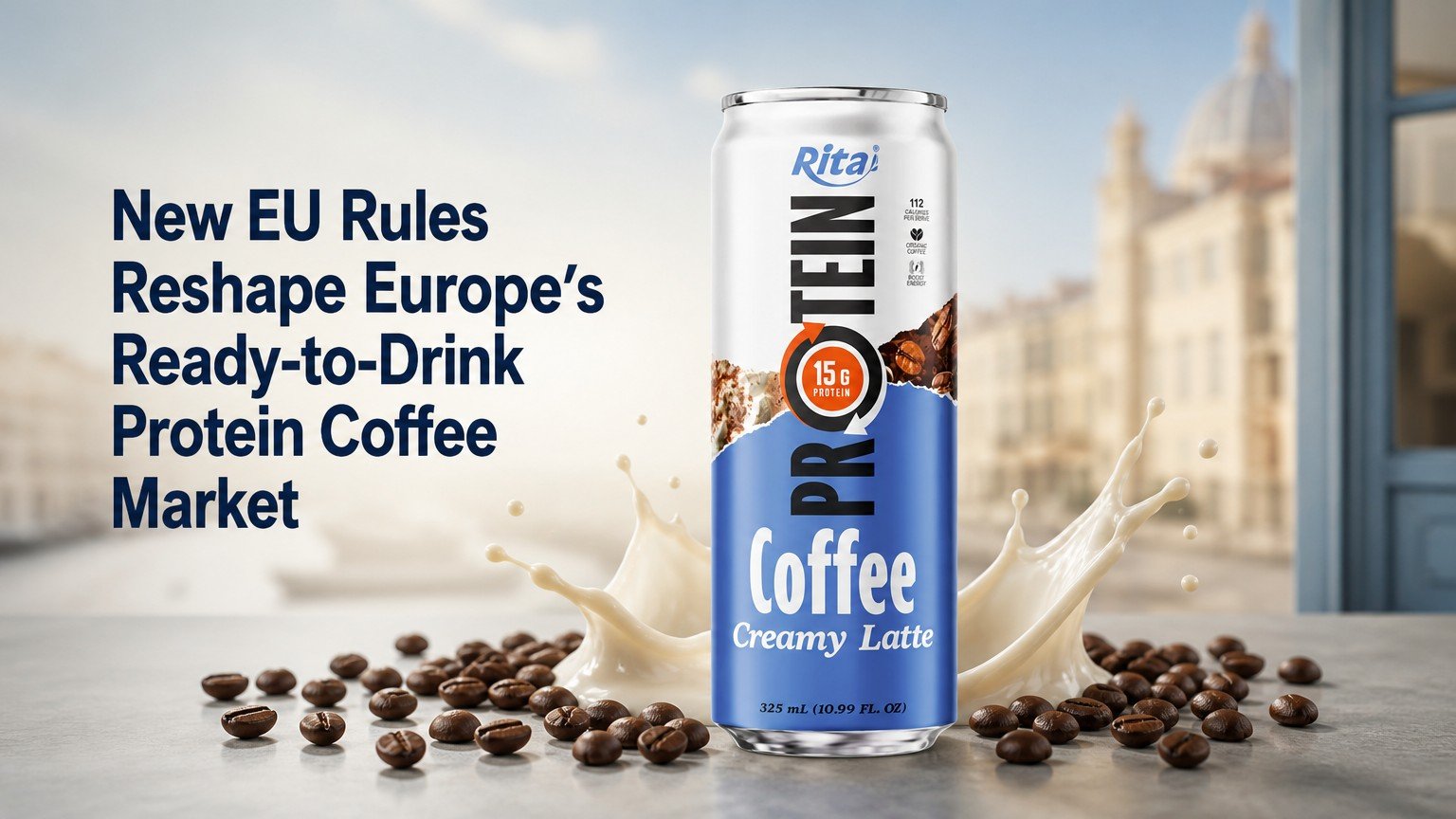
Into that environment steps Rita Protein Coffee 15g, a 325ml creamy latte can that pairs 15 g of protein with a cafe-style coffee profile and an export dossier built on internationally recognised certifications.
Key Takeaways
- European regulators are tightening scrutiny of nutrition declarations, front-of-pack labelling and claim substantiation across canned coffee beverages.
- Rita Protein Coffee 15g delivers 15 g of protein and roughly 183 kcal per 325ml can in a creamy latte format.
- Certification stacks such as BRC, FSSC 22000, Halal and Kosher increasingly act as entry tickets for European buyers.
- RITA supplies more than 200 countries and territories, offering a scalable route into European retail and travel channels.
- Wider drinks-sector headlines, from Scotch whisky import probes in India to an environmental investigation in Scotland, point to a more compliance-heavy trading climate.
Regulatory Pressure Reshapes the Ready-to-Drink Protein Coffee Category
Compliance has moved from the back office to the front of every European buying decision.
Food information rules in the European Union, led by Regulation (EU) No 1169/2011, oblige operators to present ingredient lists and nutrition declarations in a consistent format across member states. For a canned coffee beverage sold in several languages, that consistency is a legal baseline rather than a design preference. Importers in Germany and the Netherlands routinely request label proofs before a first container is even booked, and artwork changes after approval can delay a launch by an entire retail cycle.
Front-of-pack schemes and nutrition thresholds
Alongside the mandatory declaration, voluntary front-of-pack systems such as Nutri-Score have reshaped shelf conversation. France promotes the scheme officially, the Netherlands has referenced it in retail pilots, and Nordic retailers apply their own interpretive labels. A ready-to-drink protein coffee carrying 15 g of protein per can will be read differently depending on which system the retailer displays next to it.
Thresholds matter as much as presentation. Sugar, fat and sodium values per 100 ml determine how a drink sits beside competing cans, and rounding rules mean a small reformulation can shift a displayed figure. Manufacturers planning several European launches therefore validate nutrition panels against the strictest target market first, then cascade the artwork across the remaining countries. That sequencing avoids reprints, and reprints are costly when labels are shared across a full coffee drink series.
Claim substantiation for protein content
Every gram of protein printed on a can label has to be defensible under audit.
Protein declarations attract attention from market surveillance authorities, particularly where a product sits between a coffee beverage and a dairy drink. Analytical certificates, batch records and specification sheets form the evidence chain that buyers request, and that documentation travels with the shipment rather than staying behind at the plant gate. In practice, RTD coffee regulation has become a routine agenda item in distributor onboarding meetings from Hamburg to Helsinki.
- Nutrition declarations aligned to both per-100 ml and per-can serving formats
- Front-of-pack scoring accepted by the retailer, including Nutri-Score where relevant
- Ingredient and allergen transparency for milk-derived proteins such as milk protein concentrate
- Language variants prepared for Germany, France, Italy, Spain and the Nordic markets
- Extended producer responsibility and deposit-return obligations tracked country by country
Those checkpoints frame the commercial conversation around the coffee drink series catalogue and around products such as the Rita Protein Coffee 15g creamy latte can, where specification clarity matters as much as flavour when a buyer compares samples.
Market Demand for Ready-to-Drink Protein Coffee in Europe
European shoppers are buying coffee in cans faster than most cafes can pour it, and protein-forward variants are riding the same wave.
Inside the 325ml protein coffee can
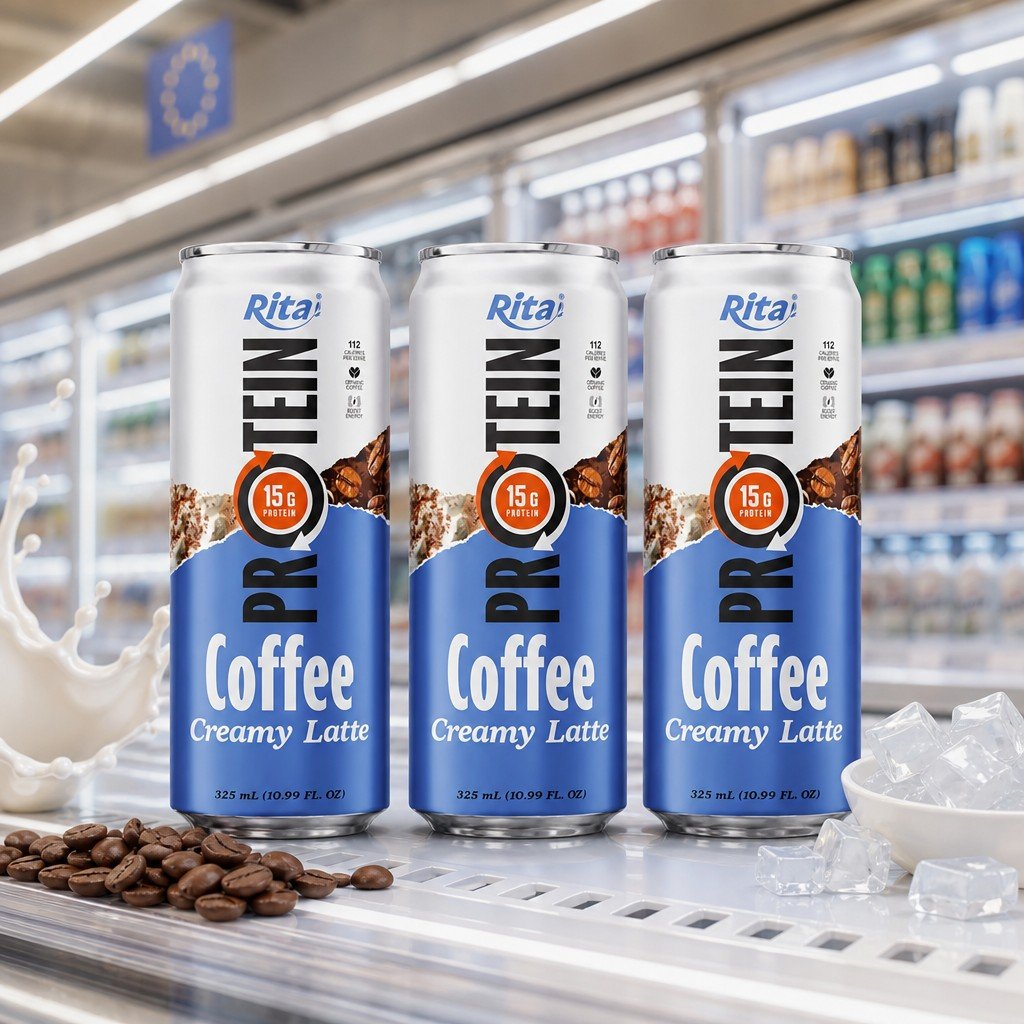
Rita Protein Coffee 15g is built on three core ingredients: whole milk powder, milk protein concentrate and instant coffee powder. Each 325ml aluminium can carries 15 g of protein and approximately 183 kcal, equivalent to 56 kcal per 100 ml, in a format designed to be opened and finished without preparation. The recipe is offered in Vanilla, Mocha and Creamy Latte, giving buyers a short flavour ladder rather than a single reference point. Full specifications are published on the Rita Protein Coffee product page, alongside packaging and shelf-life data.
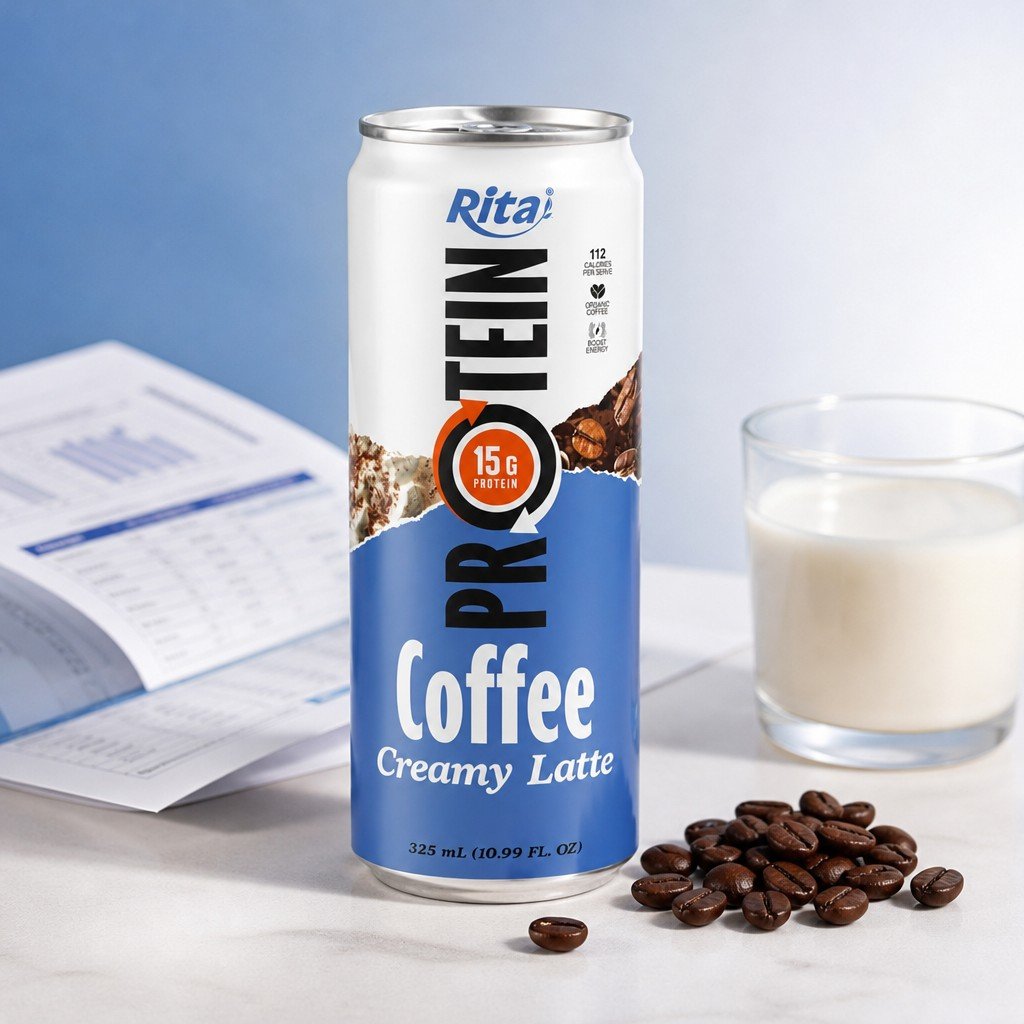
The can itself does part of the selling work. A white-and-blue split design with vertical PROTEIN lettering, an orange badge marking 15 G PROTEIN, roasted coffee beans and a creamy splash reads as premium at two metres on a chiller shelf. For a high protein coffee can competing against flavoured lattes and plain dairy drinks, that visual shorthand shortens the decision.
Where European demand is concentrating
Demand concentrates around commuting occasions and desk-side breaks rather than meal occasions. Germany, France and the Netherlands show established convenience-channel habits, Italy and Spain lean toward espresso culture yet accept canned formats in travel retail, and the Nordics pair high digital retail penetration with strict labelling expectations. A creamy latte coffee drink in a sealed can fits those patterns without asking consumers to change behaviour.
Distribution follows documentation more often than it follows taste, and the paperwork trail decides shelf access.
For exporters, the practical question is how a single can clears customs, passes label review and reaches several promotional calendars within one season. Importers ask for shelf-life data, artwork approvals and certification scope before volume is discussed, and the sequence rarely changes between Hamburg and Helsinki. Suppliers who arrive with a complete file compress weeks of correspondence into a single exchange, while suppliers who arrive with a sample and a brochure start the process from zero.
RITA beverage export volumes exceed 1,200 containers per month, and the company supplies brands in more than 200 countries and territories. That scale allows European buyers to plan promotions without negotiating container-by-container limits, and it shortens the gap between artwork approval and first delivery.
From the Vietnamese Highlands to the Export Can
Coffee flavour is decided long before a can is filled, and sourcing decisions show up directly in the cup.
Vietnam's Central Highlands remain one of the world's most productive coffee regions, with harvest seasons that shape global robusta availability and pricing. Sourcing teams time their visits around peak harvest to evaluate cherry quality, drying conditions and lot consistency before contracts are signed.
RITA follows that rhythm in its own raw-material reviews, as described in the company's account of a visit to Vietnam's coffee gardens at peak harvest season, where field conditions are assessed against the flavour profile required for a canned latte. The exercise connects agricultural variability to a repeatable taste inside a sealed 325ml format.
https://www.youtube.com/watch?v=F2yJLjUYiuo
Transparency at origin answers a question European buyers ask with growing frequency: where does the coffee in the can come from, and who verified the lot? Publishing the sourcing trail turns a routine enquiry into a short conversation, and it gives distributors a story they can repeat on shelf talkers and in tenders.
Certification Stacks and OEM Capacity for European Buyers
Certificates decide whether a sample ever becomes a shipment, and European importers read them before they read the pitch.
What European buyers verify first
RITA operates as an OEM and ODM beverage manufacturer established in 2004, running more than 50 automated production lines across a portfolio that includes tropical fruit juices, coconut products, dairy drinks, energy drinks and coffee. The company holds BRC, FSSC 22000, Halal Jakim, Halal HCA-GCC, Kosher, ISO, GMP, HACCP and SMETA credentials, and exports to more than 200 countries and territories.
| Certification | Why it matters to a European importer |
|---|---|
| BRC | Recognised by UK and European retail technical auditors |
| FSSC 22000 | Food safety management system accepted across continental retail |
| Halal Jakim / Halal HCA-GCC | Opens dual-channel distribution including travel retail |
| Kosher | Broadens eligibility for specialist and export banners |
| SMETA | Social compliance evidence requested by Nordic and Dutch buyers |
For a ready-to-drink protein coffee containing milk protein concentrate, pairing a food-safety scheme such as FSSC 22000 with Halal and Kosher scope removes friction when a distributor serves several retail banners at once. Retailers in the Nordics and the Netherlands additionally expect social-compliance evidence, which is where the SMETA audit reference becomes relevant. European beverage compliance files are assembled per shipment rather than reconstructed retrospectively, and that habit shows up in how quickly a first order moves.
Private label capability completes the picture. A buyer can develop a proprietary version of a high protein coffee can using an existing formulation or brief a new one through the research and development team, with artwork, language variants and can formats handled inside the same project brief.
The wider portfolio lets distributors build a mixed container: the full coffee drinks catalogue sits beside milk, tea and fruit lines, so a protein latte can travel with complementary references instead of arriving alone.
Broader Beverage Sector Signals Worth Watching
Regulatory headlines rarely stay inside one category, and recent weeks illustrate the point across the drinks trade.
Diageo and Pernod Ricard's Scotch whisky imports into India are under investigation, a reminder that tariff and origin disputes can reshape flows between distant markets quickly. Separately, Diageo faces a probe over a toxic spill in Scotland, placing environmental compliance back on the agenda for large producers and, by extension, for the suppliers that feed their programmes.
Corporate movement adds another layer. Amber Beverage UK has entered administration, and Canned Wine Group has acquired the South African brand New Theory.
On the conference circuit, Pernod Ricard, Suntory and De Kuyper are set to feature at the upcoming Just Drinks spirits conference, where regulatory and sourcing questions are expected to dominate the agenda. For manufacturers serving Europe, the pattern is consistent: trading conditions are being written by compliance teams as much as by marketing plans, and suppliers arriving with certificates, label proofs and traceable ingredients shorten every negotiation that follows.
In that climate a well-documented can travels further than a heavily promoted one, and European buyers are pricing that difference into every tender.
Frequently Asked Questions
What is Rita Protein Coffee 15g?
Rita Protein Coffee 15g is a ready-to-drink latte sold in a 325ml aluminium can. It combines whole milk powder, milk protein concentrate and instant coffee powder to deliver 15 g of protein and approximately 183 kcal per can, in Vanilla, Mocha and Creamy Latte variants.
Which European markets is the protein coffee 325ml can aimed at?
Primary targets are Germany, France, the Netherlands, Italy, Spain and the Nordic countries, where convenience-channel coffee consumption is established and labelling expectations are demanding. Travel retail and office refreshment channels are additional routes for the same can.
Which certifications support export of the ready-to-drink protein coffee?
The manufacturing base holds BRC, FSSC 22000, Halal Jakim, Halal HCA-GCC, Kosher, ISO, GMP, HACCP and SMETA, covering food safety, religious dietary scope and social compliance for European retail onboarding.
Can RITA develop a private label version of the can?
Yes. RITA works as an OEM and ODM partner, so a distributor can adapt an existing formulation or brief a new one, with artwork, language variants and can formats handled within the same project.
What should importers prepare before listing the product?
Label proofs in the required languages, nutrition panels verified for the target market, certification scope letters, shelf-life data and packaging responsibility registrations are the documents most European buyers request first.
Related news items:
Older news items:
- Honoring the Women of Rita Beverage on Vietnamese Women's Day 2026 - 21/10/2026 06:56
- Rita Beverage Team Building 2026: A Journey of Connection, Joy and Togetherness - 19/10/2026 06:24
- Ginger Milk Tea Peach Flavor Reshapes the RTD Tea Category - 15/10/2026 21:09
- Protein Water Demand Creates New Opportunities for Blueberry Drinks - 13/10/2026 20:51
- Supply Chain Spotlight On The Melon Drink With Nata De Coco - 11/10/2026 22:50
 084 274 3784788

 No. 8, Thong Nhat Boulevard, Song Than 2 Industrial Park, Di An Ward, HCMC, Vietnam.