
Protein Water Demand Creates New Opportunities for Blueberry Drinks

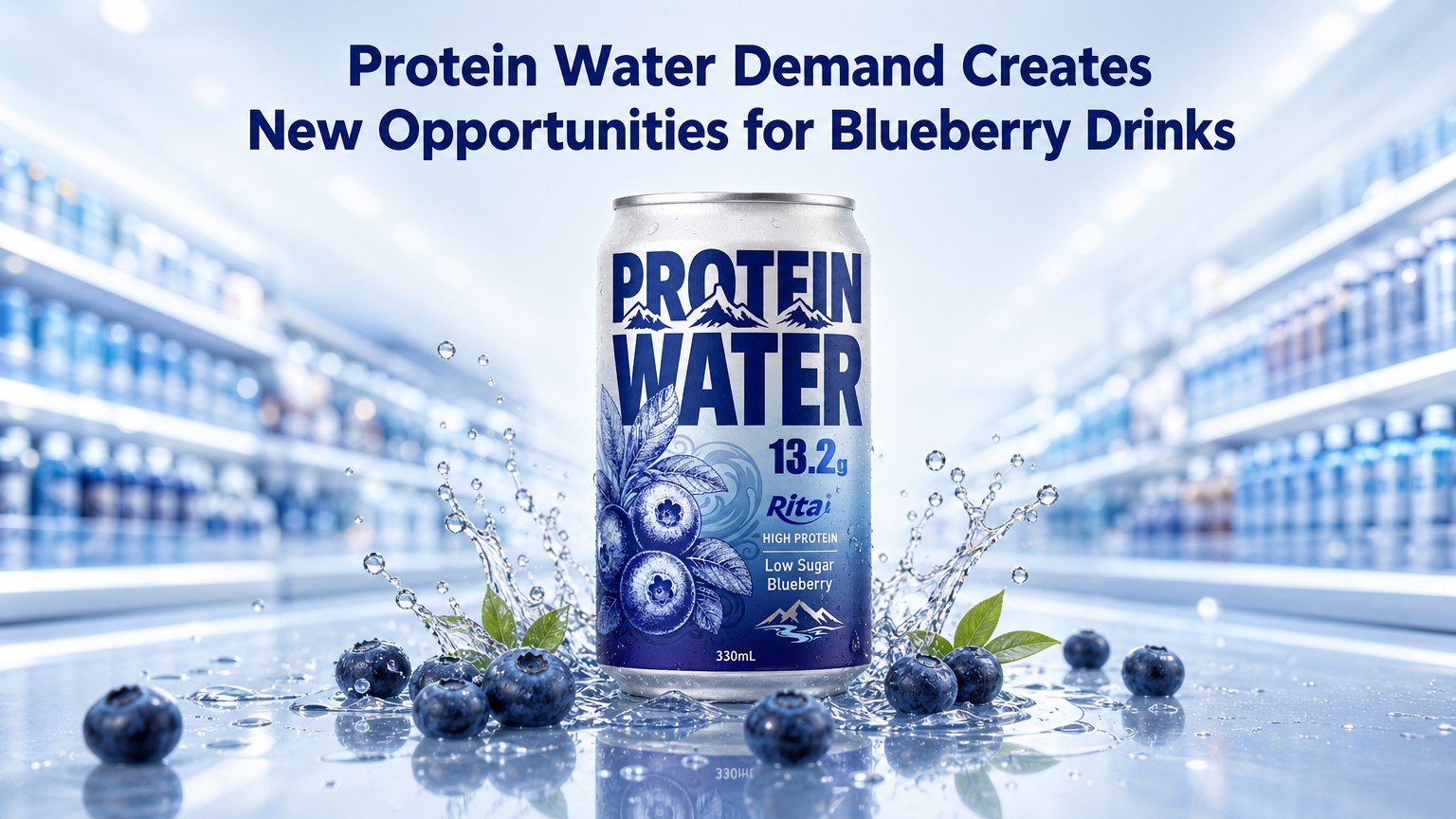
The global beverage aisle is being redrawn by shoppers who expect more from every can they pick up, and the High Protein Water Blueberry Drink from RITA arrives at precisely that moment. Packaged as a 330ml aluminium can carrying 13.2 grams of protein, minimal sugar and no fat, the drink sits in the fast-growing middle ground between plain water, sports nutrition and everyday refreshment — a shelf position that buyers across the continent are actively trying to fill.
Key Takeaways
- Protein water formats have moved out of specialty fitness channels into mainstream chilled retail, and category teams are widening listings to keep pace.
- Each 330ml can of the High Protein Water Blueberry Drink carries 13.2 grams of protein and roughly 102 calories, with minimal sugar and no fat.
- Aluminium packaging supports fast cooling, long-haul freight and e-commerce boxing — three factors that shape listing decisions.
- RITA pairs certified manufacturing with OEM and private label capacity, giving distributors one route from formula to shelf.
- Flavour-led variants such as blueberry help a crowded category differentiate on taste rather than specification alone.
Why European Retailers Are Making Room for Protein Water
Protein water has stepped out of specialty fitness stores and into mainstream chillers, and buyers across Europe have taken note.
Across Germany, France, the Netherlands, Italy and Spain, supermarket beverage teams have spent two years widening chilled ranges beyond flavoured water and isotonic mixtures. Nordic chains in Sweden, Norway, Denmark and Finland have followed a similar playbook, giving shelf space to cans that read as simply as water yet carry a specification much closer to a bottled protein shake. The logic is commercial rather than sentimental: shoppers now compare grams of protein per serving the way they once compared sugar per 100ml, and they do it in a category where margins hold up better than in standard carbonates.
Where the Category Sits on the Shelf
Most buyers place a protein water in one of two positions: beside flavoured water at eye level, or at the cold end of the functional bay next to energy and vitamin drinks. The choice matters for rate of sale, because the two locations attract very different missions — one is thirst-led, the other is specification-led.
The blueberry variant works in both settings. Its colour story is instantly recognisable on shelf, and the flavour reads as familiar rather than clinical, which helps when a shopper is scanning a row of white and grey cans. Retailers have also noticed that a 330ml format travels better through smaller store formats and forecourt coolers than a 500ml bottle, keeping facings efficient without losing volume per trip. That kind of merchandising detail decides whether a new listing survives its first range review.
What Buyers Look for in a Protein Water
Category managers run a similar filter before listing any protein water beverage, and the criteria have tightened considerably as the shelf has become crowded.
- Grams of protein per single serve, stated clearly on the front of pack
- A sugar level low enough to sit beside water rather than beside soda
- A flavour that performs cold and does not taste chalky at serving temperature
- Packaging that survives pallet transport and e-commerce boxing
- A supplier able to hold the same specification across repeat orders
Formulation consistency, not novelty, decides which cans get reordered.
Inside the High Protein Water Blueberry Drink Formulation
The specification behind this can is deliberately short, and that is the point.
Every 330ml serving delivers 13.2 grams of protein at roughly 102 calories, with a Brix level of about 10.6 and a pH near 4.1. That combination gives the drink a crisp, tangy blueberry character and a light body rather than the thickness associated with milk-based protein products. It is fat-free and formulated with minimal sugar, a profile that matches the label scrutiny now standard in European retail. The full technical sheet for the High Protein Water Blueberry Drink sets out composition, can dimensions and case configuration for buyers building a listing plan.
How the High Protein Water Blueberry Drink Compares
Placing the drink next to the two formats it competes with shows why buyers keep asking for samples.
| Format | Protein per serving | Sugar level | Typical pack | Shelf mission |
|---|---|---|---|---|
| Protein water (this product) | 13.2 g / 330ml | Minimal | 330ml aluminium can | Chilled grab-and-go |
| Flavoured water | Trace | Varies, often higher | 500ml PET bottle | Thirst-led |
| Dairy protein shake | Higher, heavier body | Usually higher | 330–500ml bottle | Planned purchase |
The gap between those columns is where the commercial opportunity sits: more protein than a flavoured water, less heaviness than a shake, and a can that chills quickly in a crowded cabinet.
Packaging and Portability Shape the Purchase Decision
For this category, the can is half the product.
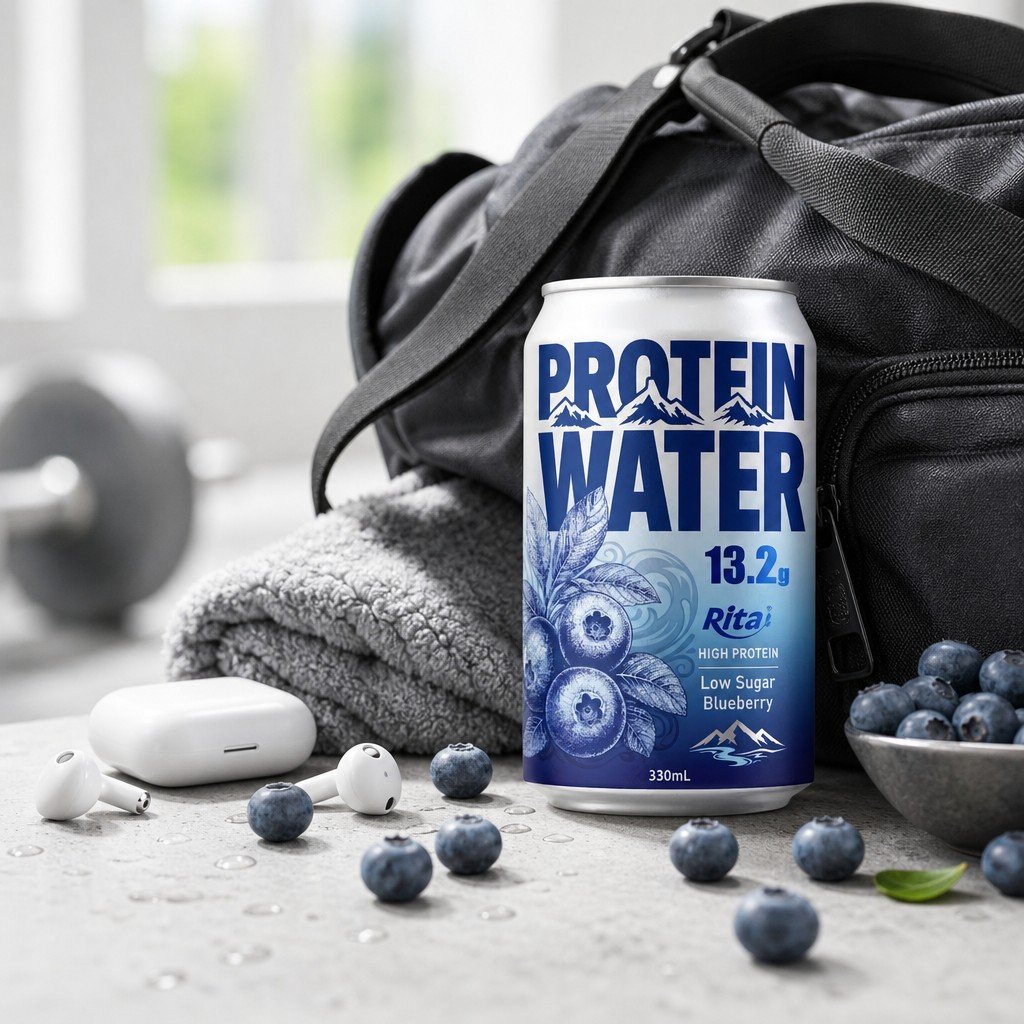
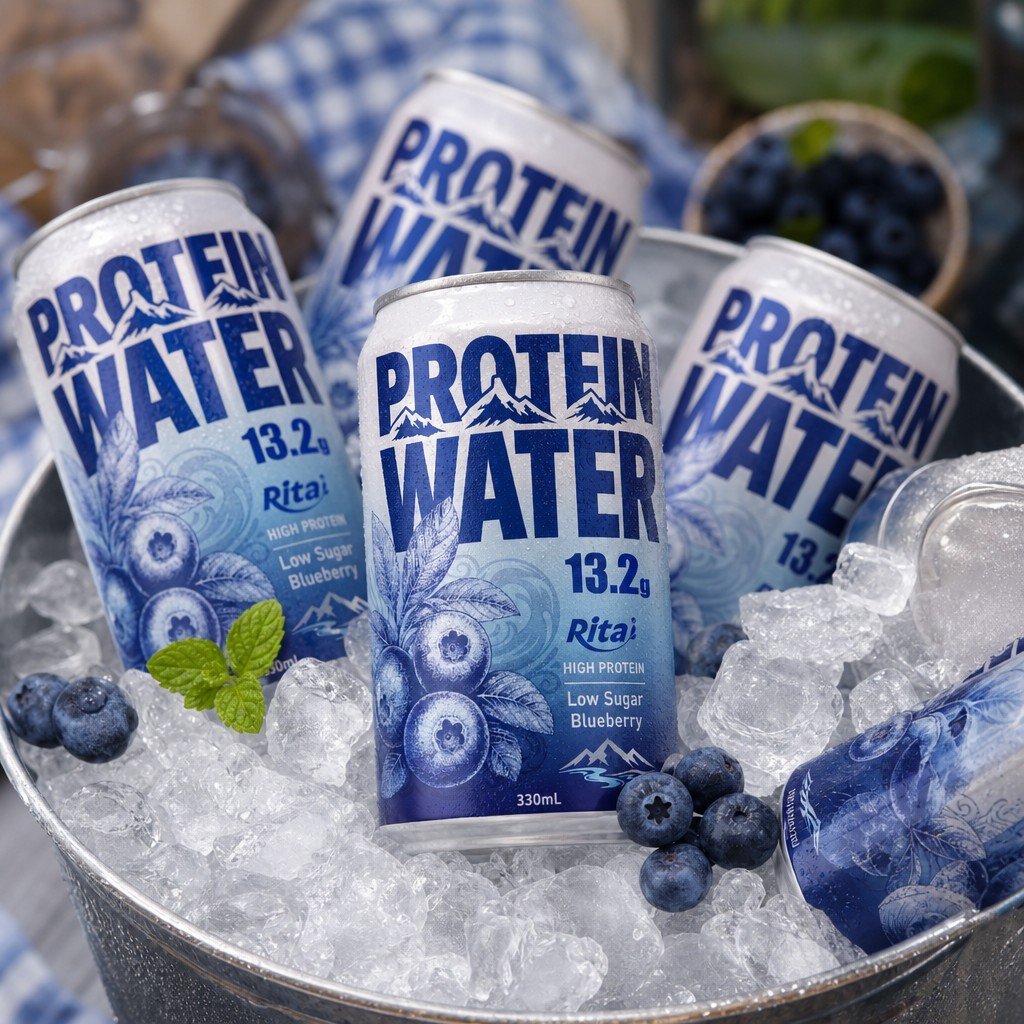
The 330ml aluminium can keeps the drink compact enough for a gym bag, a commuter's side pocket or a hotel minibar tray, while the rigid shell protects the contents through long-haul freight and last-mile delivery. Aluminium also pulls temperature down faster than PET inside a chilled cabinet, which matters when the purchase decision happens in a handful of seconds.
Design-wise, the can runs a white-to-deep-blue gradient with bold PROTEIN WATER lettering, mountain silhouettes and detailed blueberry illustrations with leaves over a swirling water pattern, with the RITA leaf logo sitting cleanly at the top. That visual language has been tested against the two failure modes of the category — looking too clinical for mainstream shoppers or too playful for specification-led buyers — and lands between them. Buyers who want a different colourway or a co-branded sleeve can specify it at the sample stage, before artwork is released to print.
Aluminium Cans and the E-commerce Question
Online orders punish weak packaging, and cans have become the safer bet for mixed-case bundles.
Retailers shipping mixed cases report fewer breakages and lower claims volumes with cans than with glass, while weight per serving stays below heavy-wall PET. The 330ml volume also sits comfortably inside standard parcel dimensions, so a twelve-can tray rarely pushes a shipment into a higher cost band. For buyers testing a 330ml protein drink can online before committing to chilled shelf space, that arithmetic tends to close the decision faster than any tasting session.
Export Market Dynamics and Trade Flows
Trade data increasingly decides which beverage concepts reach European shelves first.
Behind the figures sits a practical shift in how orders are placed. Importers are asking for smaller case packs, phased releases across several markets, and artwork changes that can be turned around between campaigns. Suppliers able to stage production rather than run a single large lot are winning more first orders, particularly when a launch has to land in several countries within the same window. Timing, rather than unit price, is becoming the deciding term in first-time contracts.
Certified Manufacturing Behind Every Can
Buyers audit the certificate file before they taste the product.
RITA Food and Drink Co., Ltd, established in 2004, operates as a Vietnamese OEM and ODM beverage manufacturer exporting to more than 200 countries and territories, with a portfolio spanning juices, coconut products, functional drinks and energy formats in cans, glass, PET and PP. The company's soft drinks catalogue shows how wide the mixing capability runs beyond any single line, and it gives buyers a quick read on adjacent formats they could range next to a protein water.
Production for European accounts is held against BRC, FSSC 22000, Halal Jakim, Halal HCA-GCC, Kosher, ISO, GMP, HACCP and SMETA audits — a list that answers most retailer technical questionnaires in the region without leaving a third-party gap. Technical teams in Germany, the Nordic countries and southern Europe tend to request the same core set, so one audit file usually travels well from one chain conversation to the next.
Protein-led formulas also sit beside the company's milk and protein beverage range, which gives formulators a reference point when they want to compare mouthfeel, sweetness targets and shelf-life expectations between formats before committing to a listing.
Private Label Routes for European Brands
For retail brands and distributors that would rather own the label than buy into a global one, the OEM service programme covers formulation adjustment, nutritional specification, can artwork and case configuration. More than 50 automated production lines and roughly 1,200 containers shipped each month give European buyers room to stage a launch across several markets without running into a single-order bottleneck. Artwork proofs and specification sheets are agreed before production runs, which keeps repeat orders predictable. That combination is what makes a private label beverage manufacturer worth shortlisting when a regional chain wants its own architecture on shelf rather than an imported brand.
Trend Winds Shaping the Broader Beverage Trade
The wider drinks trade has been unusually volatile, and the recent run of headlines says as much about strategy as about any single category. Anora moved to expand distribution through agreements with Bacardi in Sweden and Norway, a reminder that Nordic markets remain attractive entry points for portfolio brands building on established routes to shelf. In parallel, Constellation Group renewed its investment in the social tonic brand Hiyo, showing that capital still flows toward low- and no-alcohol propositions that promise a different occasion rather than a better version of an existing one.
Not every story is upbeat. Scottish distiller GlenWyvis filed for administration, the National Association of Brewers and Distillers reported continued weakness in U.S. spirits sales, and leadership changes at TKC Distilling pointed to the same pressure: categories that once relied on loyal volume now have to re-earn it. Across these updates, the pattern behind the corporate restructuring, strategic partnerships and competitive squeeze is consistent.
For beverage buyers, the practical read is straightforward — diversified formats travel better than single bets.
What Buyers Should Watch as the Category Matures
Three signals will decide whether protein water holds the shelf space it has won: repeat purchase after the first promotion, the number of additional brands a chain lists in the same bay, and whether suppliers can hold price without quietly reformulating. The specification for the High Protein Water Blueberry Drink has become one of the reference points buyers use when they benchmark that debate against alternatives.
Flavour breadth is the second lever. Blueberry gives the range an easy starting point, but conversations with category teams point to steady appetite for variants that can be ranged as a set rather than a single facing. A blueberry protein water usually sits beside a citrus or a berry mix in the same architecture, and retailers that list two or three colours tend to build a block on shelf — blocks hold their position through resets far longer than isolated facings do.
The third lever is supply reliability. Distributors comparing the High Protein Water Blueberry Drink from RITA ask the same three questions — lead time, minimum order, and the ability to flex artwork for a local promotion — and they tend to answer them before the tasting session rather than after it.
- Confirm the certificate file matches the technical questionnaire of every target chain.
- Agree artwork and specification before the first production slot is reserved.
- Plan the second flavour before the first can leaves the port, so the shelf block forms on schedule.
Buyers who treat a protein water as a program rather than a single item are the ones most likely to still be listing it after the next range review, and a high protein drink supplier with audited capacity makes that planning far easier to defend internally.
Frequently Asked Questions
What is the High Protein Water Blueberry Drink?
It is a blueberry-flavoured protein water beverage from RITA, supplied in a 330ml aluminium can. Each serving contains 13.2 grams of protein, roughly 102 calories, no fat and minimal sugar, with a Brix level of about 10.6 and a pH near 4.1 for a light, tangy taste.
What makes the flavour profile distinctive?
The formulation is designed to taste crisp and clean rather than heavy or chalky. The blueberry note stays light at cold serving temperature, which is the quality buyers test first when they compare it with milk-based protein products.
What packaging options are available?
The standard unit is a 330ml aluminium can, chosen for its rigidity during freight, fast cooling in a chilled cabinet and suitability for mixed-case e-commerce shipments. Artwork, colourway and sleeve changes can be specified at sample stage.
Can the product be supplied under a private label?
Yes. RITA offers OEM and ODM routes covering formulation adjustment, nutritional specification, artwork and case configuration, supported by more than 50 automated production lines and exports to over 200 countries and territories.
Which certifications cover production?
Production is audited against BRC, FSSC 22000, Halal Jakim, Halal HCA-GCC, Kosher, ISO, GMP, HACCP and SMETA standards, which covers the technical questionnaires used by most retail chains in Europe.
Related news items:
Newer news items:
- New EU Rules Reshape Europe's Ready-to-Drink Protein Coffee Market - 21/10/2026 07:44
- Honoring the Women of Rita Beverage on Vietnamese Women's Day 2026 - 21/10/2026 06:56
- Rita Beverage Team Building 2026: A Journey of Connection, Joy and Togetherness - 19/10/2026 06:24
- Ginger Milk Tea Peach Flavor Reshapes the RTD Tea Category - 15/10/2026 21:09
Older news items:
- Supply Chain Spotlight On The Melon Drink With Nata De Coco - 11/10/2026 22:50
- Glass Bottles and Coconut Milk Reshape the RTD Mocha Category - 08/10/2026 19:31
- Rita Team Building 2026: Ready for Hon Rom, Phan Thiet - 08/10/2026 04:54
- Sustainability Meets Flavor in Coco Sea Moss Coconut Water Launch - 07/10/2026 08:23
- How Purple Compound Juice Is Winning Over Shoppers - 07/10/2026 01:20
 084 274 3784788

 No. 8, Thong Nhat Boulevard, Song Than 2 Industrial Park, Di An Ward, HCMC, Vietnam.